Showing posts with label dental lab seo. Show all posts

Wednesday, April 24, 2019

Image result for measuring seo
One of the biggest challenges in SEO is measuring impact — we know what matters (or doesn’t matter) until the rules of the game have changed. And when they do, we’re all scrambling to find a baseline again. 
We decided to put together a list of what we consider to be steadfast SEO recommendations for your dental lab. This list has yielded wins for a number of our clients — they had an impact that we were able to identify and quantify — and might be useful to you and your clients. While not all of them may be applicable (they should ultimately be tailored to your dental labs site’s specific needs) I will provide further details and examples of what I mean within each.
Here are the five SEO recommendations that  we have consistently seen make a positive impact in dental laboratory SEO's ever-changing world.

1. Structured data matters

The short explanation of why structured data is helpful is that it tells crawlers what there is within your page. If you are not familiar with this you can follow this helpful Structured Data guide to get you quickly up and running.
This is a clear example of tailoring the advice to your site’s needs and industry — I have consistently seen structured data making a positive impact for clients in different industries, but different structured data will be required for different sites and pages within the site.
Below, I show the increase in impressions that occurred after we updated the information included on structured data of product pages. In this case, the correct type of structured data was already selected, but the information given to it was incomplete or inconsistent with what was on page:
Above is an anonymized graph of a client’s impression performance during a month after the structured data update.
Here are the industries where I’ve seen structured data being useful:
  • Jobs/recruiting
  • Events
  • Beauty services
Structured data makes it faster and easier for crawlers to understand the information within the page, making it a powerful (but often misused) tool. If applied correctly, it will make quite a positive impact on your pages.
Here are a few additional steps to help you get started:
  • Follow Google’s recommendations on SD
  • Test things out 
  • Check your competitor's page’s structured data

2. Page freshness

Your page’s freshness is determined by multiple factors, but simply having a date on a page is one of the easiest ways to indicate to Google how fresh your page is. This applies to blogs and news, but it’s also relevant for product pages related to dates, such as event sites.
If you think about page freshness from a user perspective, it’s easier to understand why it matters so much. When you obtain search results that have an old date, such as articles, depending on the subject, you might consider them less relevant than if they had a recent date. Crawlers know this too and have the ability to differentiate between fresh and old content whether it has a date or not.
For one of our clients in the dental lab industry, an old date took a toll on their rankings. After updating their page’s content to ensure it was search relevant, we went through and made sure no content within the page (i.e. page copy or text at the bottom of the page) was referring to older dates. We also updated the date on structured data to match the new date.
After the update, we observed improved ranking on SERP results, which doubled impressions and CTR.
Page freshness matters for any industry, and while dates are helpful, your content freshness should always reflect and target what users are searching. Here are a few other things to consider if you think you may need to refresh your pages:
  • How often have you conducted keyword research in the last 18 months and updated your page’s content based on keywords results?
  • Are you featured on SERP results with dates and if so how old are these dates?

3. Internal linking (still matters)

The right balance of internal linking is never a straightforward answer, so I am not here to advise you on the absolute right way to do it. However, I am here to tell you that not having too many links on one page can make a positive impact.
For example, linking to all categories from your homepage could be the best user experience or the fastest way for crawlers to discover your pages but it will also impact the amount of equity the page is sending to all the pages it links to.
If all of your category pages are crawled and indexed, as was the case for my client, you can decide to link from the homepage only to specific categories or services. There are many factors to consider when changing how you internally link from the homepage, some of which are:
  • Likelihood of these pages to better compete
  • Revenue that comes from these pages
When we recommended a change in internal linking to one of our clients in the personal beauty service industry, we saw an overall 21 percent increase in sessions from the previous month for the site as a whole. About half of these came from the category pages we kept a link to, which offset any loss in session from the category pages we excluded.
Balancing internal linking is definitely an important ranking factor because it will dictate how users and crawlers discover your pages. If you are revisiting your site’s internal linking, or think that your client should, my colleague Shannon wrote this helpful guide on the subject that covers all the various aspects of balancing internal linking for SEO.

4. Title tags

Changing your title tags and finding out if they made a positive impact can be quite difficult to prove. At DentalLabSupport, our clients can easily test and measure how a different title made a positive or negative impact. We have tested this many times for clients in different industries, and changing a title has always changed (positively or negatively) the amount of session variant pages were getting.
How you change your title will depend on your page type, so there is no absolute rule on what to change a title to. In my client's case, we’ve positively tested the following changes:

Include the year in the title, which also signals freshness. 

    Here is an example we made up:
    Original title: “Book a Trip to Hawaii Now | [brand name]”
    Changed title: “Hawaii Trips 2019/2010 | Book Now | [brand name]”

    Include the lowest product price of the page, for example:

      Original title: “Cheap Flights to Hawaii - [brand name]”
      Changed title: “Cheap Flight to Hawaii from $400 - [brand name]”
      We also tested these following changes, which had a negative result in terms of the number of sessions:
      • Adding the number of products for sale on the page to the title tag
      • Adding emojis to the title tag
      The successful tests were measured in the travel industry particularly, while the negative tests occurred in the fast fashion industry. Specifically, through the ODN platform, we measured a 7 percent increase in sessions for pages with a year or price in the title.
      What you change your title to will depend on many factors, so a year or price might not help in your case. However, if some of your category pages have seasonal products or your industry competes heavily on prices, adding the year — or date, if applicable — or a price in the title could be quite beneficial.

      5. Obtain backlinks

      One thing that consistently helped my clients to obtain external links is creative pages — not shocking, I know. These are usually interesting articles or campaigns related to the business, not commercial pages (pages that are just trying to sell something), and they end up obtaining quite a lot of coverage from different sources and, subsequently, external links.
      Building successful creative pages are not easy and won’t guarantee that an increase in any specific amount of backlinks, but it’s one of the safest ways to obtain organic backlinks. The process can also be quite expensive for big pieces but we’ve also experienced a positive impact with more lightweight pieces on a smaller budget.
      If your budget or your client’s budget is on the modest side, you can still create a great piece. Here are a few tips to achieve that:
      • Think about the data you have collected and what insights it might have for users who do not have access to it: can you spot trends and patterns that could be interesting for a wider audience?
      • Surveys: you can certainly reach an audience to ask questions on a topic you want to create a piece of content for. If you can’t reach an audience for free, you can do this cheaply through paid surveys and collect your data this way.
      • Hire freelancers: there is a lot of great talent you can scout on sites like DentalLabSupport.com to help you create a visually enticing piece

      Wrapping it up

      Measuring the impact of SEO changes is a consistent challenge and not every SEO technique you throw at content will work. My hope is that this short list can provide you with some ideas and directions on things to consider when helping your site or your clients. As I mentioned above, these are not hard written rules, but they are the ones worth their weight and are certainly worth analyzing for the sites you are working on.
      For more information about Dental Lab SEO contact DentalLabSupport.com for a free consultation. Call 1.888.715.9099 today!

      Saturday, October 6, 2018

      What is the New Google Optimization Score & How Does it Work?


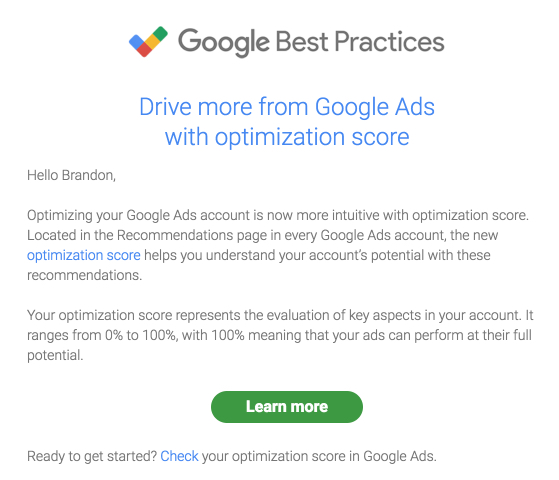
      For dental lab digital advertisers using Google Ads (formerly AdWords), there is a new feature that will help you get the most out of your ad campaigns — Google Ads optimization score.
      Google recently sent out an email informing users about the new feature:
      optimization score Google
      Don’t worry if your dental lab didn’t receive the email or are unsure how Google’s optimization score works. In this article, you’ll learn what the new feature is, how it’s calculated, and how you can improve your score.

      What is Google’s optimization score?

      Google’s ad optimization score is a percentage amount that indicates how well your dental labs campaigns are optimized based on a number of factors such as bid amounts, keyword types, bid strategy, etc. The feature was first announced in July 2018 and is now viewable for all users in the Recommendations tab in your Google Ads account.
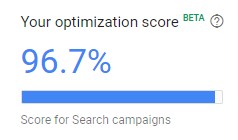
      This is how the score looks like in your account (the percentage will vary, of course):
      optimization score percentage
      While the feature is in beta, dental labs can still use their optimization score to evaluate the effectiveness of their ad campaigns. It should be noted that, this feature is only available for Google Ad users that have active Search campaigns. It is not available in AdWords Express or used by your Quality Score or Ad Rank.

      How is it calculated?

      Google’s optimization score is calculated in real-time on a scale of 0 to 100% based on your dental labs campaign’s performance and your implementation of Google’s recommendations.
      When calculating your score, Google considers your campaign’s:
      • Bids & Budgets
      • Ads & Extensions
      • Keywords & Targeting
      • Repairs
      It also factors in variables such as:
      • Statistics, settings, and the status of your account and campaigns
      • Relevant impact of available recommendations
      • Recent recommendations history
      • Trends in the ads ecosystem
      If your score does not equal 100%, Google provides recommendations and indicates how your score will be affected should you choose to apply it. A recommendation that would have a more meaningful impact on your campaign’s performance is given more weight on your overall score. This effect is represented by a “score uplift” value from <0.1% to 100%, representing the estimated impact on overall campaign performance.

      How to improve your optimization score

      Recommendations are designed to help you optimize your budget by improving bids, keywords, and ads. The end goal is to increase overall performance and efficiency of your ad campaigns.
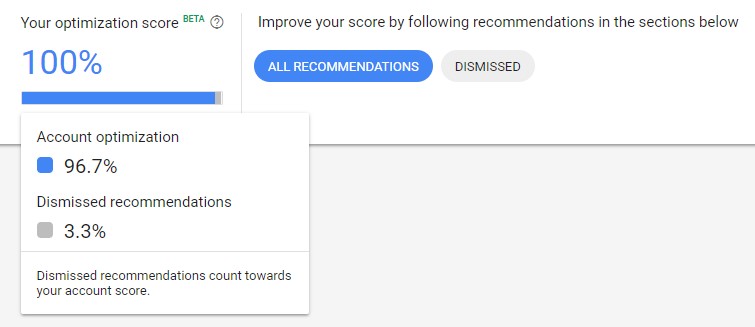
      To improve your score, you must either accept or decline Google’s recommendations. Your score will be updated no matter which option you choose. However, if you decide to dismiss the recommendations, they are represented in gray color when you hover over your score. You can view your dismissed recommendations at any time by clicking the “Dismissed” button:
      optimization score improvements
      Note: It’s important to know that your score could sum up to more than 100%. This is because some recommendations will invalidate other recommendations when accepted.

      How to check your score and accept or decline recommendations for your dental lab website

      Once you log in to your Google Ads account, click Recommendations from the left-head navigation menu. This will bring you to your Recommendations page, where at the top, you will see your optimization score:
      optimization score recommendations
      Below that, you will see any recommendations that Google has suggested for your dental labs account.
      You can view these recommendations at a glance or click “Learn more” to find out what impact each one might have and why it has been suggested for your account. If you have many recommendations, you can filter by specific category.
      If you agree with Google’s recommendations, you can click “Apply” to apply that specific one or click “Apply All” to apply all of them at once. You can also dismiss the recommendation by clicking “Dismiss.”
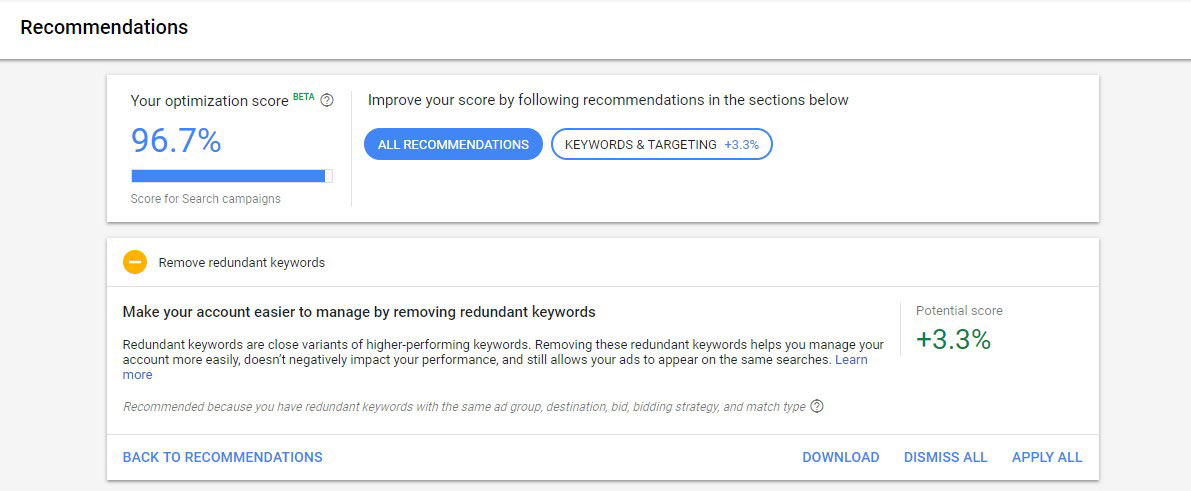
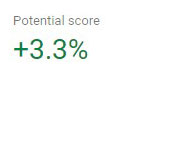
      Each recommendation will show a score uplift percentage under the label, “Potential Score” like this:
      optimization score potential score
      If this recommendation was applied, your optimization score would increase by 3.3%.

      Recommendation examples

      Recommendations are custom for each account. However, here are a few examples that you might see:
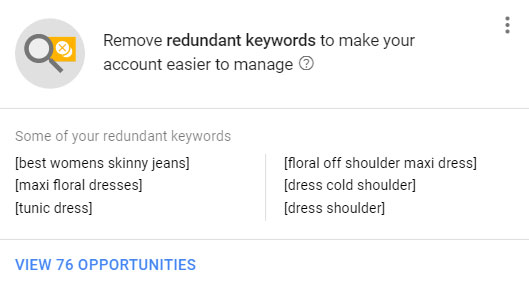
      • Remove redundant keywords: Make your account easier to manage by removing redundant keywords:
      optimization score redundant keywords
      • Promote landing pages missing from your ads: Landing pages relevant to potential customers are missing from your ads
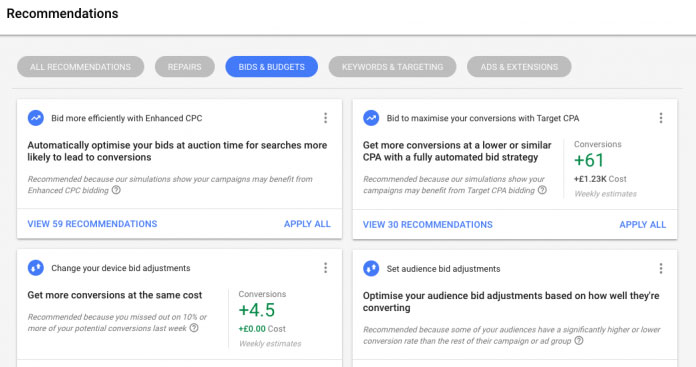
      • Bid more efficiently with Enhanced CPC: Automatically optimize your bids at auction time for searches more likely to lead to conversions
      • optimization score bids and budgets
      • Bid more efficiently with Target CPA: Get more conversions at a lower or similar CPA with a fully automated bid strategy
      Target CPA and Enhanced CPC (ECPC) are both automated bid strategies that use machine learning to increase conversions. To learn more about automated bidding.
      • Lower your bids: Lower your bids to get more clicks for the same or lower cost.
      • Raise your budgets: Keep your ads running on your busiest days by fixing your limited budget.
      • Add new keywords: Show your ads on more searches relevant to your business.
      • Improve your mobile site: Avoid losing customers on mobile devices by improving your mobile site.
      This list is only a snapshot of the potential recommendations. For a full list, please refer to Google’s help guide.

      Improve your dental labs campaign performance with DentalLabSupport landing pages

      While Google continues to make its ad platform more user-friendly through visual representations of performance (i.e. optimization score), maximizing your ads performance requires a hands-on approach in key areas of a successful ad campaign.
      To learn more about DentalLabSupport Landing Pages and see it in action, request a free demo today. Call 888-715-9099 pr info@dentallabsupport.com www.dentallabsupport.com

      Monday, June 11, 2018

      Is WordPress a good choice for SEO?

      Powering over 30% of all the websites existing over the Internet, WordPress has certainly come a long way since its release on 27 May 2003, by Matt Mullenweg and Mike Little. It’s 2018 and WordPress continues to grow, steadily yet magnificently.
      And talking of the steady growth, the last decade has seen a surge in the importance that has been given to SEO. In order to make dental labs discoverable, and in a pursuit to stay at the top of the search engine result pages (SERPs), individuals and brands are relying on SEO-powered website-building platforms.
      WordPress is definitely one of the favorite choices. But the question is whether it is a good choice for accomplishing the SEO goals that you are trying to achieve for your dental lab, so let’s find out what WordPress has to offer.

      ‘Snap-at-your finger’ optimization

      What makes WordPress a great choice for your dental lab SEO goals is its quick setup and configuration. Also, when you are logged in with your site’s dashboard and are actually filling in the SEO-powering fields of your posts’ editor, you can stay assured that things will not take a lot of time off your schedule.
      If you are new to blogging, you will definitely take your own time to get used to the fields that prompt you to add the ‘Meta description’, ‘Tags and Categories’, ‘Meta Data’, ‘Keywords’, ‘Excerpt’, etc. Once you are there, optimizing will truly be a ‘click-of-your finger’ thing.
      If you are able to save some time there, you will create much better content which is always a step forward in your content optimization journey.

      Search-engine friendly URL

      Otherwise known as permalinks, the chosen URL for your website posts is a crucial determinant of how search engines will perceive your content.  If your URL carries the power keyword from your content, that is definitely an icing on the cake.
      With WordPress, you can either choose to go with the generated permalink that is based on an ID number, or you can create your own URL. Just before you publish your post through your WordPress editor, you can choose to customize the permalink as per the summary of the post. This is a great SEO booster as the visitors as well as the search engines will be better able to understand what to expect before they even start going through the content of the post.

      Super-powerful SEO plugins

      If you know someone who is a WordPress fanatic, we bet that you have heard them rambling about how awesome WordPress plugins are. In the case of SEO, the development is similar.
      The Yoast SEO plugin and the All-in-One SEO Pack plugin are the undisputed market leaders when it comes to WordPress SEO. Their premium versions offer a set of even more powerful features than the free ones. Here are some of the amazing features offered by the free versions of each of them.
      Yoast SEO
      • Lets you write killer content
      • Full control over site breadcrumbs
      • Snippet preview
      • Google Preview
      • Advanced XML Sitemaps functionality
      • Canonical URLs
      • Readability check.
      All-in-One SEO
      • Fine tune your SEO optimizations
      • XML Sitemap support
      • Image XML Sitemap for Image SEO
      • Google AMP support and Google Analytics support
      • Advanced Canonical URLs
      • SEO Integration for e-Commerce sites, including WooCommerce
      • Automatic META tags.

      Optimization served on a generous platter

      Another great thing about WordPress being an SEO facilitator is its generosity when you are using its powerful SEO plugins. If you are just a beginner, you can still nail it down all by yourself through directives and tutorials provided. You can review website builders offered by other platforms to make a comparative study of the complexity of the tasks involved.
      The very descriptive plugin functions help you figure out what goes where. If you bump up a rock, you can always head to the WordPress Codex to know more.

      Auto-sharing features and plugins

      To complement your SEO efforts through the dashboard, you need to make sure that you are marketing your website updates well and in a timely manner. This involves sharing these updates through your social media channels so that your followers can stay in touch and have an idea of whatever’s happening with your website and business.
      However, with the abundance of social channels, manual execution of these updates can take up a lot of time. Additional plugins from the WordPress repository can help you auto-share your site updates with the audience.
      Some of these Social media sharing plugins are:
      • Sassy Social Share
      • Blog2Social: Social Media Auto Post & Scheduler
      • Revive Old Posts
      • Social Auto Poster – Premium WordPress Plugin.Tools to assist your SEO check-up

      Speedy content turn-around

      If you are a website owner or a blogger, you know that search engines rank websites that turn around content speedily or in a regular manner. WordPress has a simple yet powerful text editor that helps you to create killer content that is both engaging and informative. With plugins such as the Editorial Calendar you can schedule your content and SEO strategy well in advance.

      Faster loading time

      The most important element of an optimized website is its loading speed. If a website takes more than 2-3 seconds to load, a high percentage of visitors tend to abandon the site there and then. Even if you are doing everything as directed by your site’s SEO strategy and yet fail to take measures that make your website speedy, you are in for a huge loss. However, WordPress speed optimization plugins can help you resolve this.

      SEO-friendly themes

      WordPress also lets you download and configure SEO-friendly themes that have been optimized for speed and performance. Check out some of the best SEO-friendly themes for 2018.
      Contact DentalLabSupport.com for more details.

      Friday, September 23, 2016

      Google Penguin 4.0 Live - What You Need To Know


      Image result for penguin 4.0

      Earlier today, Google announced the launch of Penguin 4.0 as a core part of their algorithm. We've been on the lookout for this release for most of this year. The rumors and news from Google about launch dates, how it might work, and other details have been like reading a tabloid. 
      We have done a lot of prep work, including Penguin Awareness Month, evolving our product, and bundling tools like the Link Audit feature into our product for no charge. Read on for more information about Penguin 4.0 and frequently asked questions.
      Key features:
      • Penguin is now real-time. Historically, the list of sites affected by Penguin was periodically refreshed at the same time. Once a webmaster considerably improved their site and its presence on the Internet, many of Google's algorithms would take that into consideration quickly, but others, like Penguin, needed to be refreshed. With this change, Penguin's data is refreshed in real time, so changes will be visible much faster, typically taking effect shortly after we recrawl and reindex a page. It also means we're not going to comment on future refreshes.

      • Penguin is now more granular. Penguin now devalues spam by adjusting ranking based on spam signals, rather than affecting ranking of the whole site.

      What Is The Penguin Algorithm?

      First introduced in April 2012, the Penguin update was created to target sites that used “spammy” tactics and manipulative practices that violate the Google webmaster guidelines.
      The last update was in the Fall of 2014 and sites impacted by that update have been waiting two years for another update.

      Is It Still Rolling Out?

      Yes, and it is expected to be fully rolled out in a couple weeks.
      It is now a real-time part of Google’s core search algorithm, which means that once it fully rolls out, it will be a constant process rather than periodic updates, as it's been previously.
      Google:
      • With this change, Penguin’s data is refreshed in real time, so changes will be visible much faster, typically taking effect shortly after we recrawl and reindex a page.

      If rankings are fine now, do we think there will be any more changes?

      No one will know the impact until it has fully rolled out.
      Once it rolls out, it will be a real-time part of the core algorithm.
      Keep in mind that Google is constantly making changes to its algorithm to improve the user experience, so with Penguin now as part of the core algorithm, it is more important than ever to ensure that your links are following quality guidelines.

      If rankings have gone down, what should we do?

      Don’t panic. It will still be rolling out for the next couple weeks. We have already seen some client’s ranking bounce around and then settle back into their previous position.

      Friday, December 11, 2015

      Lead Capturing Best Practices: The Landing PageBy:  David H. Khalili
      Any inbound marketing effort depends on effectively capturing leads. If you focus your energy on using your dental lab website to generate leads, you should be absolutely sure that the process you have in place maximizes your resources in capturing them as well as it possibly could. Over the next few weeks, we will look at the various factors that influence this process. Today, we'll begin with best practices for the core aspect of capturing leads on your website: the landing or conversion page.
      Dental Lab landing pages, of course, are the pages to which your visitors navigate - from a social media post, email, or call to action button on your website - when they're ready to make the leap and become a lead. A variety of factors play into the success of this page, and we'll discuss all of them in the post below.

      The Landing Page Content

      As you can probably imagine, the content of your landing page can make or break its success in capturing leads. You want to be convincing enough about the value you can offer your visitors that they're compelled to fill out your form (more on that later) and become a lead, without being so pushy that they bounce off your page.
      Another danger in writing your dental lab landing page content is to become too exhaustive; more quickly than you can anticipate, your well-intended copy can turn into a wall of text that no mobile user will read. Instead, keep it short, use bullet points and subheads where needed, focus on the benefits of signing up, and include plenty of visuals to keep your audience engaged.
      One type of content is so successful, it deserves its own section:

      Social Proof

      Social proof on your landing page means testimonials of past users that your visitors can relate to and add credibility to your claims. You can add these testimonials as short paragraph or, even better, as videos that show your visitors the claims and success stories come from real customers.
      Social proof from peers is so successful and important in capturing leads because it appeals allows you to verify your claim from an independent source. Of course, that also means you should be careful not to include testimonials that are so positive, they seem unbelievable. Instead, tell the story of your customers and include images at the very least to make them seem as real as possible. 

      Attention Ratio

      Web visitors are easily distracted, so including multiple opportunities for them to click or take action takes away their attention from what should be the main goal, which is to get them to fill out a form and become a lead.
      So Gardner proposed the following idea, which has since been verified in multiple studies: the fewer opportunities you have for your users to do anything but fill out the form, the greater the chance they'll take the desired action. In other words, you should not include links to other pages, your social media profiles, or even your site's navigation on your landing page. Instead, the only way to take action for your visitors should be to fill out the lead conversion form, which is exactly what you want them to do.

      The Conversion Form

      Speaking of which: as you can imagine, your conversion form is a major factor in whether your visitors do or do not become leads. A wide range of factors go into creating an optimum conversion form that maximizes your lead capturing success. Stay tuned for a post that discusses this topic in more detail.
      For more information please visit DentalLabSupport.com or call 1-888-715-9099.

      Thursday, September 24, 2015

      How to Choose The Best Social Media Marketing Services

      The Best Social Media Marketing Services


      When it is time for your business to assign resources for social media marketing, consider utilizing a skilled marketing firm.  With the right marketing in place, your social media activities can generate plenty of qualified leads that will easily convert into customers.
      Social media marketing services have a lot of value.  Review the following checklist to make sure you get the most out of your social media marketing services firm:Who Provides The Best Social Media Marketing Services
      Online marketing strategy – does the firm provide alignment with your overall online marketing strategy and your social media marketing initiatives?  Make sure there is coordination between your web site campaigns, emails and your social media posts so that you can fully capitalize on your marketing campaign investment.

      Timing and frequency – work with your social media marketing services partner to make sure your posts are timed based on your target audience preferences.  Some marketing companies simply default to early morning social media posts.  This can be a crucial mistake because some target markets may prefer to look at social media posts at other times of the day, so your timing is important.  Make sure to review and test some posts at various times to determine what is the most effective.  Also there is a balance in the frequency of posts.  Too many social media posts can flag your business as spam or abusive.  Too few social media posts can be ignored entirely.  Again, monitoring and tuning is an essential part of social media marketing services.

      SEO – search engine optimization (SEO) should be utilized in all social media activities.  This not only makes the most out of your keyword and phrase research, but it also helps you to improve your overall search engine rankings.

      Feedback – review all feedback and comments from social media activities and be as interactive as possible with your target audience.  Even when the comments are negative you should handle them professionally according to your business philosophy and culture.  The right approach can turn a negative post into a good learning experience for other readers that foster loyalty and engagement.

      For more information please call us directly info@dentallabsupport.com or 1-888-715-9099.  Thank you. www.DentalLabSupport.com