
Showing posts with label Dental Labs. Show all posts

Saturday, October 6, 2018

What is the New Google Optimization Score & How Does it Work?


For dental lab digital advertisers using Google Ads (formerly AdWords), there is a new feature that will help you get the most out of your ad campaigns — Google Ads optimization score.
Google recently sent out an email informing users about the new feature:
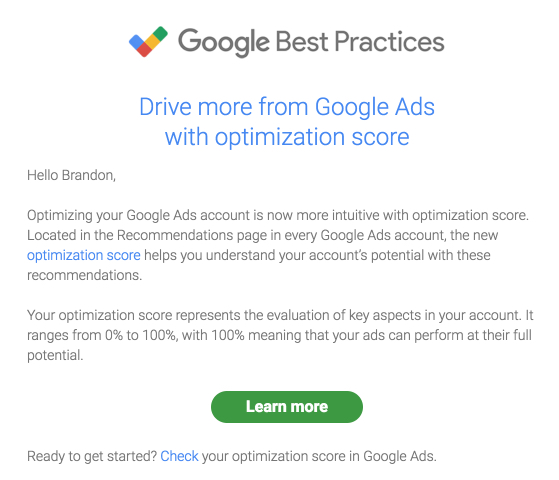
optimization score Google
Don’t worry if your dental lab didn’t receive the email or are unsure how Google’s optimization score works. In this article, you’ll learn what the new feature is, how it’s calculated, and how you can improve your score.

What is Google’s optimization score?

Google’s ad optimization score is a percentage amount that indicates how well your dental labs campaigns are optimized based on a number of factors such as bid amounts, keyword types, bid strategy, etc. The feature was first announced in July 2018 and is now viewable for all users in the Recommendations tab in your Google Ads account.
This is how the score looks like in your account (the percentage will vary, of course):
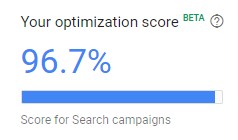
optimization score percentage
While the feature is in beta, dental labs can still use their optimization score to evaluate the effectiveness of their ad campaigns. It should be noted that, this feature is only available for Google Ad users that have active Search campaigns. It is not available in AdWords Express or used by your Quality Score or Ad Rank.

How is it calculated?

Google’s optimization score is calculated in real-time on a scale of 0 to 100% based on your dental labs campaign’s performance and your implementation of Google’s recommendations.
When calculating your score, Google considers your campaign’s:
  • Bids & Budgets
  • Ads & Extensions
  • Keywords & Targeting
  • Repairs
It also factors in variables such as:
  • Statistics, settings, and the status of your account and campaigns
  • Relevant impact of available recommendations
  • Recent recommendations history
  • Trends in the ads ecosystem
If your score does not equal 100%, Google provides recommendations and indicates how your score will be affected should you choose to apply it. A recommendation that would have a more meaningful impact on your campaign’s performance is given more weight on your overall score. This effect is represented by a “score uplift” value from <0.1% to 100%, representing the estimated impact on overall campaign performance.

How to improve your optimization score

Recommendations are designed to help you optimize your budget by improving bids, keywords, and ads. The end goal is to increase overall performance and efficiency of your ad campaigns.
To improve your score, you must either accept or decline Google’s recommendations. Your score will be updated no matter which option you choose. However, if you decide to dismiss the recommendations, they are represented in gray color when you hover over your score. You can view your dismissed recommendations at any time by clicking the “Dismissed” button:
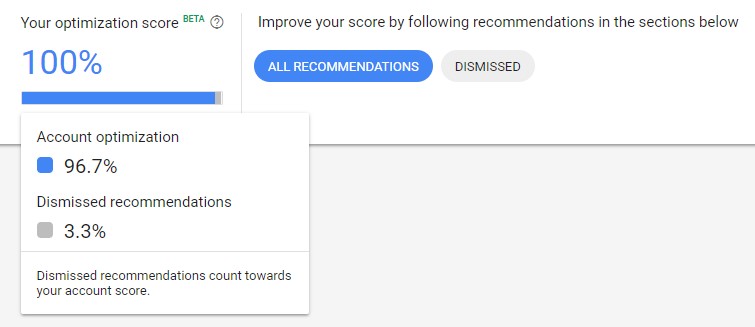
optimization score improvements
Note: It’s important to know that your score could sum up to more than 100%. This is because some recommendations will invalidate other recommendations when accepted.

How to check your score and accept or decline recommendations for your dental lab website

Once you log in to your Google Ads account, click Recommendations from the left-head navigation menu. This will bring you to your Recommendations page, where at the top, you will see your optimization score:
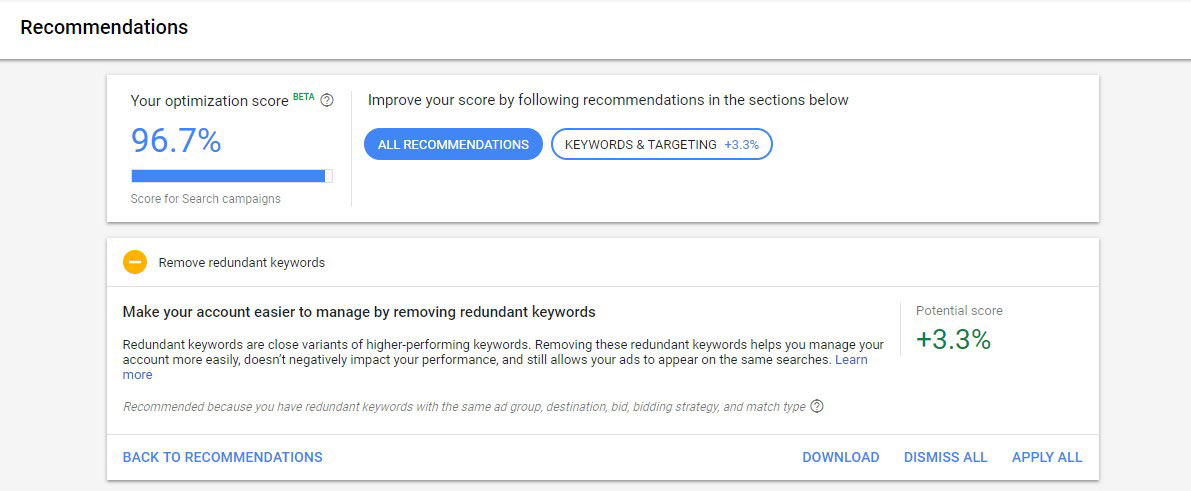
optimization score recommendations
Below that, you will see any recommendations that Google has suggested for your dental labs account.
You can view these recommendations at a glance or click “Learn more” to find out what impact each one might have and why it has been suggested for your account. If you have many recommendations, you can filter by specific category.
If you agree with Google’s recommendations, you can click “Apply” to apply that specific one or click “Apply All” to apply all of them at once. You can also dismiss the recommendation by clicking “Dismiss.”
Each recommendation will show a score uplift percentage under the label, “Potential Score” like this:
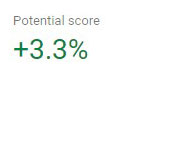
optimization score potential score
If this recommendation was applied, your optimization score would increase by 3.3%.

Recommendation examples

Recommendations are custom for each account. However, here are a few examples that you might see:
  • Remove redundant keywords: Make your account easier to manage by removing redundant keywords:
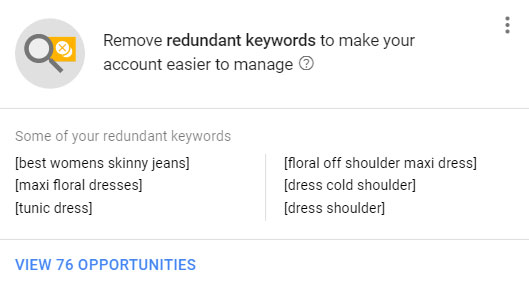
optimization score redundant keywords
  • Promote landing pages missing from your ads: Landing pages relevant to potential customers are missing from your ads
  • Bid more efficiently with Enhanced CPC: Automatically optimize your bids at auction time for searches more likely to lead to conversions
  • optimization score bids and budgets
  • Bid more efficiently with Target CPA: Get more conversions at a lower or similar CPA with a fully automated bid strategy
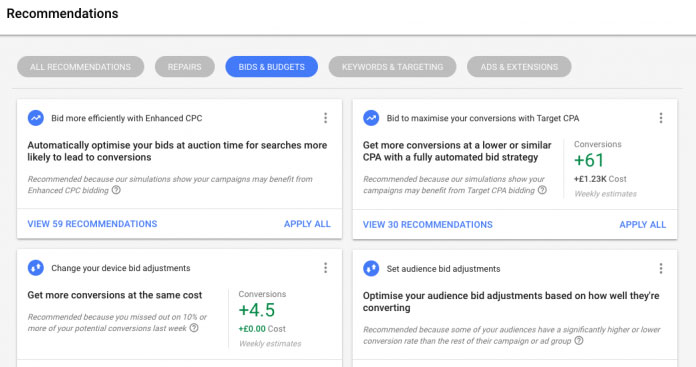
Target CPA and Enhanced CPC (ECPC) are both automated bid strategies that use machine learning to increase conversions. To learn more about automated bidding.
  • Lower your bids: Lower your bids to get more clicks for the same or lower cost.
  • Raise your budgets: Keep your ads running on your busiest days by fixing your limited budget.
  • Add new keywords: Show your ads on more searches relevant to your business.
  • Improve your mobile site: Avoid losing customers on mobile devices by improving your mobile site.
This list is only a snapshot of the potential recommendations. For a full list, please refer to Google’s help guide.

Improve your dental labs campaign performance with DentalLabSupport landing pages

While Google continues to make its ad platform more user-friendly through visual representations of performance (i.e. optimization score), maximizing your ads performance requires a hands-on approach in key areas of a successful ad campaign.
To learn more about DentalLabSupport Landing Pages and see it in action, request a free demo today. Call 888-715-9099 pr info@dentallabsupport.com www.dentallabsupport.com


Monday, June 11, 2018

Is WordPress a good choice for SEO?

Powering over 30% of all the websites existing over the Internet, WordPress has certainly come a long way since its release on 27 May 2003, by Matt Mullenweg and Mike Little. It’s 2018 and WordPress continues to grow, steadily yet magnificently.
And talking of the steady growth, the last decade has seen a surge in the importance that has been given to SEO. In order to make dental labs discoverable, and in a pursuit to stay at the top of the search engine result pages (SERPs), individuals and brands are relying on SEO-powered website-building platforms.
WordPress is definitely one of the favorite choices. But the question is whether it is a good choice for accomplishing the SEO goals that you are trying to achieve for your dental lab, so let’s find out what WordPress has to offer.

‘Snap-at-your finger’ optimization

What makes WordPress a great choice for your dental lab SEO goals is its quick setup and configuration. Also, when you are logged in with your site’s dashboard and are actually filling in the SEO-powering fields of your posts’ editor, you can stay assured that things will not take a lot of time off your schedule.
If you are new to blogging, you will definitely take your own time to get used to the fields that prompt you to add the ‘Meta description’, ‘Tags and Categories’, ‘Meta Data’, ‘Keywords’, ‘Excerpt’, etc. Once you are there, optimizing will truly be a ‘click-of-your finger’ thing.
If you are able to save some time there, you will create much better content which is always a step forward in your content optimization journey.

Search-engine friendly URL

Otherwise known as permalinks, the chosen URL for your website posts is a crucial determinant of how search engines will perceive your content.  If your URL carries the power keyword from your content, that is definitely an icing on the cake.
With WordPress, you can either choose to go with the generated permalink that is based on an ID number, or you can create your own URL. Just before you publish your post through your WordPress editor, you can choose to customize the permalink as per the summary of the post. This is a great SEO booster as the visitors as well as the search engines will be better able to understand what to expect before they even start going through the content of the post.

Super-powerful SEO plugins

If you know someone who is a WordPress fanatic, we bet that you have heard them rambling about how awesome WordPress plugins are. In the case of SEO, the development is similar.
The Yoast SEO plugin and the All-in-One SEO Pack plugin are the undisputed market leaders when it comes to WordPress SEO. Their premium versions offer a set of even more powerful features than the free ones. Here are some of the amazing features offered by the free versions of each of them.
Yoast SEO
  • Lets you write killer content
  • Full control over site breadcrumbs
  • Snippet preview
  • Google Preview
  • Advanced XML Sitemaps functionality
  • Canonical URLs
  • Readability check.
All-in-One SEO
  • Fine tune your SEO optimizations
  • XML Sitemap support
  • Image XML Sitemap for Image SEO
  • Google AMP support and Google Analytics support
  • Advanced Canonical URLs
  • SEO Integration for e-Commerce sites, including WooCommerce
  • Automatic META tags.

Optimization served on a generous platter

Another great thing about WordPress being an SEO facilitator is its generosity when you are using its powerful SEO plugins. If you are just a beginner, you can still nail it down all by yourself through directives and tutorials provided. You can review website builders offered by other platforms to make a comparative study of the complexity of the tasks involved.
The very descriptive plugin functions help you figure out what goes where. If you bump up a rock, you can always head to the WordPress Codex to know more.

Auto-sharing features and plugins

To complement your SEO efforts through the dashboard, you need to make sure that you are marketing your website updates well and in a timely manner. This involves sharing these updates through your social media channels so that your followers can stay in touch and have an idea of whatever’s happening with your website and business.
However, with the abundance of social channels, manual execution of these updates can take up a lot of time. Additional plugins from the WordPress repository can help you auto-share your site updates with the audience.
Some of these Social media sharing plugins are:
  • Sassy Social Share
  • Blog2Social: Social Media Auto Post & Scheduler
  • Revive Old Posts
  • Social Auto Poster – Premium WordPress Plugin.Tools to assist your SEO check-up

Speedy content turn-around

If you are a website owner or a blogger, you know that search engines rank websites that turn around content speedily or in a regular manner. WordPress has a simple yet powerful text editor that helps you to create killer content that is both engaging and informative. With plugins such as the Editorial Calendar you can schedule your content and SEO strategy well in advance.

Faster loading time

The most important element of an optimized website is its loading speed. If a website takes more than 2-3 seconds to load, a high percentage of visitors tend to abandon the site there and then. Even if you are doing everything as directed by your site’s SEO strategy and yet fail to take measures that make your website speedy, you are in for a huge loss. However, WordPress speed optimization plugins can help you resolve this.

SEO-friendly themes

WordPress also lets you download and configure SEO-friendly themes that have been optimized for speed and performance. Check out some of the best SEO-friendly themes for 2018.
Contact DentalLabSupport.com for more details.

Tuesday, May 22, 2018

Why Timing Matters in Sales Automation for Dental Labs

sales_automation


It's all about timing. Even the most well-intended sales automation strategy can fall apart if you don't reach your leads while they're most receptive to your message. And after reading this post, you'll understand just why this timing is so crucial, while learning best practices that help get you to better Sales Automation for your dental laboratory.
Timing Matters For Your First Email
Sales automation, as you might be aware, begins with the first email a contact receives from you after signing up and becoming a lead. And at this early stage, timing is already crucial: a study by the Harvard Business Review found that leads are no less than seven times more likely to become customers if they're followed up with in an hour or less. 
Unfortunately, most businesses do not take advantage of this fact. The same study also found that the majority of businesses don't follow up with their leads until at least 12 hours after the initial sign up. As you can imagine, this delay can result in a significant opportunity cost. But it's also an opportunity! If you follow up with your leads quickly and efficiently, you will not only increase the likelihood of turning them into customers - you'll also stand out from and make a better impression on potential customers than your competition.
Timing Matters Throughout the Funnel
Of course, the timing of your emails is not only important during the first part of your sales automation process. Instead, you should take special care that your automated emails are timed just right in order to optimize your lead nurturing efforts. That's true both in terms of the frequency with which you send emails, and the actual times at which your emails arrive in your audience's inbox.
There's a fine line between persistence and pestering. While most leads will welcome an email about once a week with dental industry and company updates, they will frown upon daily emails that keep pushing them toward making a sale. The best frequency will depend on your exact industry, but according to research firm MarketingSherpa, there is a clear correlation between an increase in frequency beyond once a week and a decrease in email performance. In general, once a week is a good goal to shoot for - as long as you have interesting content to share.
Timing Matters When Closing the Deal
Thanks to a fast follow-up email along with well-timed emails throughout the sales automation process, you're getting plenty of sales-qualified leads. As it turns out, timing matters one more time: when closing the deal. Put simply, you don't want to miss out on sales opportunities by missing the perfect window to make that sales call.
That's where lead scoring comes in, a process that allows you to determine which leads are ready to become customers based on their interactions with you. We've covered lead scoring extensively on this blog, but would be remiss not to mention it as a crucial mechanism to get the timing in your marketing automation just right.
Sales automation, in short, is all about the timing: from sending your first email to scheduling your lead nurturing efforts all the way to closing the deal, taking action at exactly the right time means increasing your chances of growing your customer base. And a good CRM can help with all of these efforts! Contact us to learn more. 
DentalLabSupport.com Sales & Marketing Platform Developed For Dental Labs 1.888.715.9099 - info@dentallabsupport.com

Monday, March 26, 2018

Dental Lab Marketing Strategy

Image result for how marketing strategies
David H. Khalili, DentalLabSupport.com
Developing a marketing strategy is vital for any dental laboratory. Without one, your efforts to attract customers are likely to be haphazard and inefficient.
The focus of your strategy should be making sure that your products and services meet customer needs and developing long-term and profitable relationships with those customers. To achieve this, you will need to create a flexible strategy that can respond to changes in customer perceptions and demand. It may also help you identify whole new markets that you can successfully target.
The purpose of your marketing strategy should be to identify and then communicate the benefits of your dental lab offering to your target market.
Once you have created and implemented your strategy, monitor its effectiveness and make any adjustments required to maintain its success.
This guide helps you identify which customers to focus on and your key objectives in reaching them. It explains what to include in your dental lab marketing strategy and how it can be used as the basis for effective action.

KEY ELEMENTS OF A SUCCESSFUL MARKETING STRATEGY

One of the key elements of a successful marketing strategy is the acknowledgement that your existing and potential customers will fall into particular groups or segments, characterized by their "needs". Identifying these groups and their needs through market research, and then addressing them more successfully than your competitors, should be the focus of your strategy.
You can then create a marketing strategy that makes the most of your strengths and matches them to the needs of the customers you want to target. For example, if a particular group of customers is looking for quality first and foremost, then any marketing activity aimed at them should draw attention to the high quality service you can provide.
Once this has been completed, decide on the best marketing activity that will ensure your target market know about the products or services you offer, and why they meet their needs.
This could be achieved through various forms of advertising, exhibitions, public relations initiatives, Internet activity and by creating an effective "point of sale" strategy if you rely on others to actually sell your products. Limit your activities to those methods you think will work best, avoiding spreading your budget too thinly.
A key element often overlooked is that of monitoring and evaluating how effective your strategy has been. This control element not only helps you see how the strategy is performing in practice, it can also help inform your future marketing strategy. A simple device is to ask each new customer how they heard about your dental lab.
Once you have decided on your marketing strategy, draw up a marketing plan to set out how you plan to execute and evaluate the success of that strategy. The plan should be constantly reviewed so it can respond quickly to changes in customer needs and attitudes in your industry, and in the broader economic climate.

UNDERSTANDING YOUR STRENGTHS AND WEAKNESSES

Your strategy must take account of how your dental lab' strengths and weaknesses will affect your marketing.
Begin your marketing strategy document with an honest and rigorous SWOT analysis, looking at your strengths, weaknesses, opportunities and threats. It is a good idea to conduct some market research on your existing customers at this point, as it will help you to build a more honest picture of your reputation in the marketplace.
Strengths could include:
  • personal and flexible customer service
  • special features or benefits that your product offers
  • specialist knowledge or skills
Weaknesses could include:
  • limited financial resources
  • lack of an established reputation
  • inefficient accounting systems
Opportunities could include:
  • increased demand from a particular market sector
  • using the Internet to reach new markets
  • new technologies that allow you to improve product quality
Threats could include:
  • the emergence of a new competitor
  • more sophisticated, attractive or cheaper versions of your product or service
  • new legislation increasing your costs
  • a downturn in the economy, reducing overall demand
Having done your analysis, you can then measure the potential effects each element may have on your marketing strategy.
For example, if new regulations will increase the cost of competing in a market where you're already weak, you might want to look for other opportunities. On the other hand, if you have a good reputation and your key competitor is struggling, the regulations might present the opportunity to push aggressively for new customers.

DEVELOPING YOUR MARKETING STRATEGY

With an understanding of your dental lab's' internal strengths and weaknesses and the external opportunities and threats, you can develop a strategy that plays to your own strengths and matches them to the emerging opportunities. You can also identify your weaknesses and try to minimize them.
The next step is to draw up a detailed marketing plan that sets out the specific actions to put that strategy into practice.
Questions to ask when developing your strategy
  • What changes are taking place in our dental lab environment? Are these opportunities or threats?
  • What are our strengths and weaknesses?
  • What do I want to achieve? Set clear, realistic objectives.
  • What are customers looking for? What are their needs?
  • Which customers are the most profitable?
  • How will I target the right potential customers? Are there groups that I can target effectively?
  • What's the best way of communicating with them?
  • Could I improve my customer service? This can be a low-cost way of gaining a competitive advantage over rivals, keeping customers, boosting sales and building a good reputation.
  • Could changing my products or services increase sales and profitability? Most products need to be continuously updated to maintain competitiveness.
  • Could extending my product list or service provision meet existing customers' needs more effectively? Remember that selling to existing customers is generally more cost effective than continually trying to find new ones.
  • How will I price my product or service? Although prices need to be competitive, most dental labs find that trying to compete on price alone is a poor strategy. What else are my customers interested in? Quality? Reliability? Efficiency? Value for money?
  • What is the best way of distributing and selling my products?
  • How can I best promote my products? Options might include advertising, direct marketing, exhibiting at trade fairs, PR or marketing on the web.
  • How can I tell if my marketing is effective? Check how your customers find out about your dental lab. A small-scale trial can be a good way of testing a marketing strategy without committing to excessive costs.

TIPS AND PITFALLS

Before looking at new markets, think about how you can get the most out of your existing customer base - it's usually more economical and quicker than finding new customers.
Consider whether you can sell more to your existing customers or look at ways of improving the retention of key customers.
Focus on the market
Your marketing strategy document should:
  • analyse the different needs of different groups of customers
  • focus on a market niche where you can be the best
  • aim to put most of your efforts into the 20 per cent of customers who provide 80 per cent of profits
Don't forget the follow-up
  • Approach a third party for feedback about your strategy - they may be able to spot any gaps or weaknesses that you can't see.
  • Put your marketing strategy into effect with a marketing plan that sets out the aims, actions, dates, costs, resources and effective selling programmes.
  • Measure the effectiveness of what you do. Be prepared to change things that aren't working.
Pitfalls to avoid
  • Making assumptions about what customers want.
  • Ignoring the competition.
  • Trying to compete on price alone.
  • Relying on too few customers.
  • Trying to grow too quickly.
  • Becoming complacent about what you offer and failing to innovate.