
Wednesday, September 18, 2019

Multi-touch Direct Mail Campaigns To Get A Better Response


I often hear from dental lab industry marketers that they want to “test direct mail marketing” and my first response is to recommend multi-touch direct mail campaigns.

What surprises me is how often marketers that are new to direct mail are thinking they’ll send out a single touch of say, 500 pieces to evaluate “whether direct mail works” for them. If it works, great. If not, they’ll plan to move on to something else.

That’s a shame because like so many aspects of business, especially with dental laboratories it often takes more than one send to generate the desired response.

And drawing broad conclusions such as “direct mail doesn’t work” from just one mailing results in plenty of missed opportunities.

Experienced direct mailers understand the need to use multiple touches to maximize the impact of a campaign, and are planning to implement a consistent testing strategy across each touch.

They know direct mail “works”. It’s a matter of finding the right audience, offer and creative.

You’d Fire A Salesperson That Gives Up After One Touch

Think about it this way: If you’re a salesperson, would you make one phone call, leave a message, and if you don’t get a call back just give up on that prospect?

Of course not. You’d probably try to contact that prospect a few more times because it often takes more than one attempt to make a sale. It’s always been that way and always will be.

Multi-touch marketing is at the core of the way modern business is conducted. Direct mail works the same way.

You don’t often see pattern of “single touch” in other forms of media. Whether running traditional offline ads in magazines or on TV or engaging with prospects online, do you run just one ad and call it a day?

No way!

Think about how long ads on a topic you’ve researched online follow you around — on Facebook, websites, and apps you use — for days, if not weeks.

So why should direct mail be any different?

It’s not, and you don’t need to take my word for it. According to Mike Schultz, President of the RAIN Group, says it can take an “average of 8 touches to get an initial meeting (or other conversion) with a new prospect” and in some cases it can take more.

Multi-touch marketing: Communicate with hot prospects again and again


I guess one silver lining is that because so many organizations give up way too soon, you can benefit from your competitor’s mistakes!

When you consider how direct mail pairs excellently with other forms of media — both online and offline — an integrated campaign can deliver results far more impressive than with one type of media alone.

In fact, many DentalLabSupport.com clients use direct mail in conjunction with their email campaigns. I consistently hear from our clients that there’s a combined lift when both are used.

Properly timed, email supports direct marketing campaigns and direct mail boosts email response rates. Consider these research findings:

According to a 2019 USPS white paper, The Future of Direct Mail Is Here and It’s Dynamic, 60 percent of marketers surveyed said that combining digital and direct mail increased ROI — with 68 percent reporting increased website visits.

A Target Marketing “Media Usage Survey” described a controlled study in which a print-only campaign produced a 6 percent response rate while the same campaign distributed through both print and email lifted that response rate by more than 25 percent — to 7.6 percent.

A DentalLabSupport Marketing survey reported that more than half of all small businesses use three or more marketing channels.

And with today’s automated tools, marketers can more quickly take action based on how prospects respond online — whether visiting a website, clicking a link in an email, or interacting through social media — using that information to retarget prospects with personalized direct mail that can be sent instantly to a printer/mailer for processing.

Multi-touch direct mail for the full buyer’s journey


How can you best use this integration of multiple communication channels?

One way is through pre-defined workflows designed to meet specific goals such as building awareness, generating leads, nurturing leads, promoting events, and more. But even using direct mail alone delivers better results when you don’t give up too soon.

Here’s a sample email/direct mail campaign designed to reactivate cold or dead leads. Which do you think has a better chance of energizing an old lead – a single direct mail or this multi-touch marketing campaign?
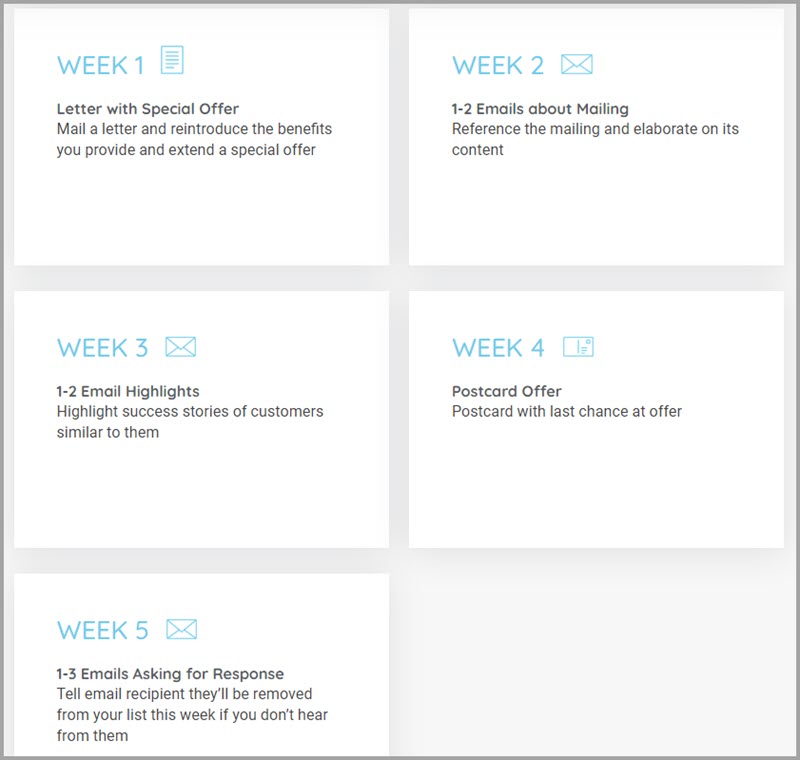


Whether you combine other channels or not, it’s important to understand that a successful multi-touch direct mail campaign requires more than simply sending out several mailings one after the other. When each is strategically timed to influence prospects along the buying journey, you can enjoy more successful results.

Attribution Makes Direct Mail Click

You see, what makes direct mail an exceptional offline media channel is that you get precise attribution you don’t get with mass media such as print ads or TV.

By using automatically generated, personalized URLs (pURLs), you can track online response (or non-response) across each “mail drop” or touch of a multi-touch direct mail campaign.. By using pURLs as the “bridge” between your mailings and the online experience, you get both the impact and high response of direct mail and the tracking and analytics you expect from digital marketing channels.

An example campaign: How multi-touch mailings multiply results

Here’s an example that shows how multiple mailings might work. Let’s assume that you sell an e-learning solution offering home-based tutoring in a wide variety of skills for students in grades K-12.

You might start a campaign with an initial sequence of three different direct mail packages (which could be sent along with email) each focusing on a different benefit — perhaps based on skills taught, age range, ease of use, etc.



A response to any of the three mailings would trigger another sequence of the multi-touch direct mail based on that specific benefit.

If there’s no response to the first mailing, you send another, and then another. If there’s no response after three mailings, you might give up on that prospect (for now, anyway).

If you do get a response, another sequence designed around the benefit that drove that response begins. These mailings might include a higher commitment offer — for example, a sales call. If there’s no response, that specific sequence might continue for another two or three mailings.

Here’s how these multi-touch marketing sequences look. First, you’d have three initial emails designed to segment prospects into specific follow-up mailing sequences:

Initial flow

No response Response

Offer A1 Offer A2 Responder Flow X

Offer A2 Offer A3 Responder Flow Y

Offer A3 Stop mailing for now Responder Flow Z

Then, each follow-up sequence can be structured in a similar way – but customized to the first offer the prospect found relevant:

Responder Flow X No response Response

Offer X1 Offer X2 Sales call

Offer X2 Offer X3 Sales call

Offer X3 Stop mailing for now Sales call

Responder Flow Y No response Response

Offer Y1 Offer Y2 Sales call

Offer Y2 Offer Y3 Sales call

Offer Y3 Stop mailing for now Sales call

Responder Flow Z No response Response

Offer Z1 Offer Z2 Sales call

Offer Z2 Offer Z3 Sales call

Offer Z3 Stop mailing for now Sales call

You can intersperse email into this flow, allow for special mailings to be sent if a prospect visits your website, a specific web page, or downloads a specific resource. Yes, this seems as if this flow would be complex to set up, but today’s automated direct mail platforms integrate with marketing automation tools to make this exceedingly easy and affordable.

Even just a few years ago, a multi-touch campaign like this would be far too complex and costly to execute. For example, sending a direct mail piece within a few hours of a visit to your website might mean sending only a few mailings per day. The fixed costs of setting up printing and mailing — which are the same whether sending 10 or 10,000 pieces — would have been prohibitive.

So don’t give up – at least not too soon. Because if at first you don’t succeed, that next mailing could be the one that triggers a profitable sale.

Automated segmentation for multi-touch marketing


Better yet, today’s direct mail tools are automated to segment your audience based on their response (or non-response) and send subsequent direct mail pieces with specific creative customized for each segment.


Each part of a multi-touch direct mail campaign can be scheduled to target these precise segments through simple campaign wizards — without the need to manually tabulate responses and build lists for each mailing.

For example, if you send a direct mail postcard and get a response to a specific offer, you may send another direct mail piece, perhaps a thank you letter, a week later with another offer.

If you don’t receive a response, you might send another postcard, perhaps highlighting a different benefit of the same offer.

You can even test various approaches as your campaign continues – so you can gain even more insights into what works and what doesn’t. For more information on best practices for testing, review my latest post here

DentalLabSupport.com


Sponsored By:
 Pm Tech


Thursday, August 22, 2019

LEAD GENERATION SOFTWARE: WHEN TO USE IT AND WHEN TO AVOID IT

One lead generation software

LEAD GENERATION SOFTWARE: 

WHEN TO USE IT AND WHEN TO AVOID IT

When it comes to dental lab lead generation software and platforms, there are two things to keep in mind:
  1. If your dental lab's sales pipeline management process is broken, lead generation software won’t fix it on its own
  2. However, if your dental lab's sales pipeline management process is well-defined, lead generation software can help you scale it
In other words, once you have all your sales ducks in a row, you can achieve more while doing the same (or less!) with the right toolkit in place.
We’re passionate about lead generation software because it helps salespeople do what they do best: sell.
It empowers reps to lead productive sales conversations and dig deep into their prospect’s pain points instead of getting lost in admin work.
The wrong sales software will slow your sales team down; the ideal one will cut hours of admin work and make them fly through their day with ease.
In this guide, we’re diving into the ins and outs of using lead generation software to help your sales team hit their quota efficiently and consistently.
Lead Generation Funnel

Why you should use lead generation software

The answer to this question seems pretty obvious, right? Lead generation software lets you automate the search for new prospects.
That’s true, but there’s so much more a lead generation software can do for you beyond that.

Effortlessly prioritize sales workload

When you manually search for leads and take the time to contact them through cold emails and cold calling, it can take a long time before your efforts land on fertile ground.
In other words, you could spend hours on the phone with the wrong people before your first productive conversation of the day, or even the week!
This happens because a list of cold prospects is just that: a list of unqualified, unscored leads whom you know almost nothing about.
How does lead gen software make this happen? Here are a few examples:
  • Leads who download lead magnets and become part of your mailing list could reveal their interests in the links they click through on your newsletters
  • A person that visited your website five times in the last week and viewed ten or more pages is probably more interested than someone who visited just once
  • A lead that filled out your contact form and wrote a long, detailed message is probably more invested than someone who only wrote a few words
This is the type of information your reps can never gather on their own, without the help of software.
The verdict here is an easy one: lead generation software platforms uncover key information about your incoming leads and helps your team work on hot leads first. It creates urgency and helps you not to waste key opportunities.

Route leads to the right sales rep

A great sales team is made out of people who are driven, assertive and confident while staying empathic, humble and honest.
They also set high standards when it comes to the velocity and size of the deals they close, their sales pipeline health, and their close rate.
The best sales team, however, is the one where everyone knows their undeniable strength and uses it to work through sales conversations and challenges. They use this advantage to complement the rest of their team.
Lead routing can help you make the most out of these strengths. Lead routing is the process of distributing new leads between your sales reps.
When you use a lead generation software, leads that come in have to be assigned to sales reps anyway, so why not use it mindfully, based on what your reps are best at?
Here are some examples:
  • Some reps may win more deals over the phone, while others succeed over email or in-person
  • If you sell based on geography, your reps will probably know certain areas better than others
  • Certain reps may close deals easily with small companies, while others may excel at selling to mid-size and large enterprise
If you aren’t yet routing leads based on specific skills, start with something simple and expand over time.

Streamline lead generation from all channels

Finally, a lead software platform shouldn’t be an isolated tool that pumps prospects into your sales pipeline.
It’s supposed to be a tool that streamlines and combines the work your sales team does along with the marketing team’s efforts.
This is why it’s important to ensure your sales and marketing teams are synced up and on the same page when it comes to leads they’re targeting. All software that either team is using should follow suit.
Here are a few things to keep in mind when synchronizing your sales and marketing teams:
  • All channels used to collect leads should be integrated with the same CRM software to send leads to
  • Key messages around your company and product should be coherent between your website and other channels
  • All lead generation forms should ask for crucial information the sales rep needs
In other words, all the touchpoints your lead goes through should be aligned.
The messaging on Facebook ads should match the tone of voice on your website. The lead forms should make it easy for reps to filter high-priority leads and understand where they came from.
Ultimately, this process should, above all, be simple to go through. It shouldn’t add more complexity to your team’s daily schedules; it should make it more straightforward and productive.

LeadBooster can help you filter leads from your website

DentalLabSupport’s new chatbot LeadBooster is fully customizable tool and can be put on any page of your website to ask visitors qualifying questions and route hot leads to the right salesperson.
LeadBooster Gif

DentalLabSupport.com LeadBooster can qualify leads based on the criteria you set, then assign quality leads to the most relevant salesperson based on things like location, availability, experience level or expertise.
Once qualified, you can decide how the information should be stored in LabCell CRM, which will automatically create a new contact as well as the associated deal information. You can set the owner of the lead and control who is allowed to see it.
You can even prompt your prospect to arrange a call, meeting or demo within the chat sequence. Leadbooster integrates seamlessly with DentalLabSupport.com Scheduler, allowing the lead to check the relevant salesperson’s availability and set up a time slot that suits.

When you shouldn’t use lead generation software

With all the benefits of using a lead generation software, are there times when you shouldn’t use it?

It generates more leads, but they’re less qualified

Your team is swimming in more leads than ever before, so things must be going great, right?
Not quite. Let’s say each of your reps was generating 25 leads each week manually. They did so by researching your industry and looked for companies similar to your existing clients. After conducting cold calls and emails, they qualified 15 of them and moved them further down the pipeline and worked from there.
The new lead generation software is bringing 70 new leads per week for each of the reps. That’s almost three times as much, so it implies it’s a good thing. However, as your reps start reaching out to their new leads, they find that they still only manage to qualify about 15 of them, but it takes them three times longer to go through them all.
Their increased efforts result in the same or worse results, making them less productive! Lead generation software should make each rep’s time more valuable instead of adding more menial tasks to their plate.

Your sales pipeline is clogged

This can happen as a result of the above scenario, but it’s possible you’ve just never considered cleaning out a messy pipeline and dropping cold or unqualified leads.
What makes a clogged sales pipeline?
  • Leads that have been in it for longer than your typical sales cycle
  • Leads that have gone cold and become unresponsive
  • Unclear sales funnel stages and an inability to sort leads in your lead gen software and/or CRM based on those stages
  • Unclear next steps for leads
  • Inability to forecast sales for the upcoming month or quarter
If your CRM resembles any of the above signs, using a lead generation software can only create more mess. If you don’t have a process to sort and act on all the new leads that will come in, a lead generation software will be a waste.
If your pipeline needs to be rebuilt from the ground up, do it before you implement a lead generation software and you’ll do yourself and your team a huge favor for a long time to come.
One lead generation software

The one lead generation software you can’t be without

Your company’s website is your internet house. You’re the homeowner. Everything else is rented or borrowed space.
Here’s what we mean by that.
For many businesses, social networks like Facebook and Instagram have been instrumental in their initial success. They easily reached thousands of their followers daily. Their posts easily went viral and grew their audience.
Then, Facebook (and later Instagram) introduced an algorithm that changed the way posts are shown on users’ news feeds. Companies that used to easily reach all 5,000 of their followers suddenly only reached 2% of that total!
In other words: platforms you’re using care about themselves first. In Facebook’s case, many companies started relying on Facebook ads to replace the reach and impact they had organically. As a result, Facebook’s US advertising revenue has tripled since 2014.
With that in mind, even paid advertising (on any platform!) is still not something you own as any updates may mean you have to spend more money to get the same results.
You don’t own any of the platforms where you’re ‘renting’ space along with millions of other users. Your website is the place where you have the ultimate say and can fully control the experience a visitor goes through—and turn them into a lead and a customer down the line.
On top of that, it gives you the benefit of collecting and analyzing your website traffic so you can learn about people and companies interested in your products.
Now you might be thinking: ‘My traffic analysis only gives me numbers and percentages, how does this help me?’
The answer? Alongside Leadfeeder, your Google Analytics data is a sales rep’s dream come true.
Leadfeeder is a sales intelligence tool that monitors your website traffic and turns it into quality leads. It gives you the company information, details about their visit, powerful filtering options, and easy lead routing so you can always know the best-suited reps are working on each opportunity.
This is a goldmine because no matter how good your offers and lead magnets are, only a small percentage of your traffic will convert through your website CTAs. The majority will just vanish.
Here’s what makes Leadfeeder the lead generation software so useful:
  • Automatic lead scoring. Your hottest, most interested leads (based on their visit history and other details) are placed at the top of your list. This way, your reps can focus on them straight away and drive a productive sales conversation. Talk about sales prioritization!
  • Cross-channel campaign power-up. If your marketing team is running an AdWords campaign, your team can capitalize on it even more by filtering leads from it, along with their visit details. Knowing what message and call-to-action took your prospect to the website in the first place provides extra lead background.
  • A shortened path to connection. Leadfeeder will show you if you’re connected on LinkedIn with someone who works at a company it identified on your website. This way, you can forget the awkwardness of a cold call and kick conversations off with ease. Read our cold calling scripts article for more tips on how to leverage common connections.

How to roll out new sales software to your team

Whether you’re just implementing a CRM software for the first time or you’re looking to upgrade it with integrations, additional features and power-ups, forming new habits around software can be difficult.
Your team might resist change at first and, even if it removes friction from their daily activities, they may be slow to fully adopt it and use it daily.
Here are our top tips to roll out new software in your sales team.

1. Keep an open line of communication

Your communication with the team might already be open and driven by trust. Whether or not that’s the case, when you come to your team with new software you want them to use, they might not immediately see the purpose of it or your intention behind it.
When it comes to new software for a team of any size, it’s bound to impact everyone’s daily habits and routines.
This means there’s a risk your sales team will think you want to track all of their daily activities and micro-manage them, which can clearly create some friction.
To avoid this kind of jumping to conclusions, announce the new software you want to implement and clearly outline the reasons you believe it will improve the process. For example, you may want to improve the follow-up process of your team, so the new sales software will help with timely reminders and notes.
After you’ve announced this change, make sure each rep can easily ask for clarifications, share their thoughts, and offer suggestions. An open feedback channel is gold.

2. Decide and announce the time and frequency recommended for the new software

Make expectations obvious and reasonable. If you don’t, some of your reps might update it daily, while others may wait for a spare moment every week or two. As a result, you’ll have incorrect data and the software won’t serve its purpose.
These expectations can be as simple as: end of the day, weekly on Friday, or daily before the work-in-progress meeting. The more frequently the tool is used (without creating unnecessary admin work), the more accurate the data in it will be as it reduces the chance for something being forgotten.

3. Establish that using the new sales software isn’t optional

Just like the point above, it’s important to convey to your reps that using the new software isn’t optional or something they can opt out of doing.
Of course, the best way to do this isn’t to be forceful and punish those that aren’t following the usage frequency. Instead, make sure your reps know the advantages they’ll experience from using the software.
For example, if they log their activities such as emails, email lead generation, calls, follow-ups and proposals, they will see how each of those impacted their results at the end of the month—and use it to improve in the following month.
Again, keep an open, ongoing communication loop and identify which parts of their new habits require support or adjustment.

4. Share the information available from the software

After some time using the software has passed, you’ll be able to share new findings and provide deeper insight into your team’s process and results than ever before.
Once you do, make it obvious. Show how the software has increased productivity, reduced the sales cycle, or converted more leads. This will also help you show your sales reps that what they do daily genuinely matters and makes a difference for the entire team, which will lift up your team’s morale, too!

5. Agree on and announce the exact date of new software implementation

As with everything above, be transparent about when the new software will be implemented. If you plan on doing a trial period first, let your team know how long the trial will be.
Announce a clear timeline so that your reps can familiarize themselves with the tool’s features, capabilities and workflows. This will also allow them to seek technical and usability support if they need it—in a timely manner.
Over time, using a sales software should turn into an automated behavior, a habit that doesn’t drain your team’s willpower or energy. It becomes a tool that speeds up and streamlines everything they do on a daily basis.

The time to prioritize your sales opportunities is now

To make lead generation software worth its while, it has to feed into your entire sales process. It won’t make an impact you desire if it’s all you rely on to make your sales team productive and hit targets.
You need a tool that helps your team track leads, manage their pipeline, and take timely action on the hottest leads.
Because if a lead was hot months ago, but you only followed up now, you’re probably late.
A powerful CRM is the ideal way for you and your team to keep track of incoming leads and make meaningful moves to take those leads through each of the pipeline stages.
However, CRMs can make life in a sales team more complicated than it was. They might…
  • Add more admin work because they don’t integrate with other key tools you use
  • Require a massive time and money investment into training
  • Create anxiety because you have to keep inputting tasks and reminders manually (and always worry you’ll forget to do so)
This setup doesn’t help your team. In fact, it probably creates friction and frustration; your team might also resist adopting such software, even if you followed all the steps for rolling it out effectively.
DentalLabSupport is different. It’s built for minimum input and maximum output so that your sales team can focus on doing what they do best.
This means less time spent on admin and more time for productive sales conversations.
How is this possible? Here’s how.
DentalLabSupport does the heavy lifting for you. Because it syncs with your email inbox and calendar, automates alerts and uses templates, it removes the hours your team spends on admin. This also means your reps will get reminders to follow up with hot leads and never let a great sales opportunity again slip away.
DentalLabSupport keeps you organized and in control. When your dental lab lead generation software sends a new lead to your dashboard, your lead tracking better be in place. Track how your team is doing and provide real-time feedback on important deals. DentalLabSupport dashboards are visual (with simple drag-and-drop function to move deals in your pipeline!), intuitive, and fully customizable.
DentalLabSupport is driven by an activity-based dental lab selling philosophy, using activity prompts, reminders, and a simple interface to focus your team on the actions they control instead of stressing about the outcomes they can’t.
Ready to generate leads for your dental lab that turn into closed deals in a heartbeat? Start your 14-day free trial to find out why thousands of sales teams prioritize their sales opportunities with DentalLabSupport.com.
Call 888-715-9099 to supercharge your dental lab.

Friday, August 16, 2019

TOOLS AND TECHNIQUES TO POWER UP YOUR PIPELINE


Sales Lead Generation


Dental Lab Marketing - Lead Generation

When it comes to lead generation, quality leads can be very important for your dental lab. 
Your team closes deals faster and with more energy when they’re dealing with quality sales leads. But when they’re working with poor leads, they lose motivation and end up in a vicious cycle of overworking to find leads, only to discover they’re not qualified at all and having to start again.
With the right dental lab lead generation strategies and tools in place, you can ensure your sales team always focuses their time and energy in the right place and with the right leads.

Sales lead generation drives the whole sales funnel 

Sales lead generation is the key element of a healthy sales pipeline—especially its earliest and widest part: the top of the sales funnel.
A sales pipeline that’s filled to the brim means that there’s plenty of leads to work on, making it easier to deal with sales quotas and expectations.
However, potential issues come up when the leads entering the pipeline aren’t of great quality. If that’s the case, it can set your sales team’s success for several reasons:
  • Leads that only look good, but turn out to be a poor fit for your service, could give your sales team false confidence
  • Your sales reps will spend valuable time chasing these leads only to discover they were never going to buy in the first place
  • Your team won’t have time to focus on quality leads, which will dilute their close rate
As a result, sales targets won’t get hit, morale can crash and, the worst-case scenario, your team won’t bring in the revenue the company needs them to.
At first, you may not see a problem with lead generation. Instead, you’ll see a drop in performance, a couple of missed targets and a longer-than-usual sales cycle.
If your sales results start frequently dropping below the usual results even though nothing about your sales pipeline or process changed, make sure to review your sales lead generation.
Because no matter how good your sales process is, it won’t turn bad leads into good ones—and you often won’t know they’re bad until you’ve spent hours on them.
You can always recognize a healthy dental lab sales pipeline when:
  • A solid mix of leads enters the funnel
  • Deals move through at a steady rate
  • A predictable number of deals are won
If this becomes less of a case even though your sales activities and process haven’t changed, it’s time to reconsider where your leads are coming from and the criteria your team is using to qualify them.

The ideal lead checklist: which leads are worth your time?

When your sales reps notice patterns in their best leads, a checklist will help them look for similar patterns in newly generated leads.
Start with this checklist and expand it based on your individual situation, such as industry or company size you’re selling to. If your lead checks the following boxes, they are worth the effort!
Basic criteria:

☐ Prospect matches ideal customer persona

☐ Business challenge aligns with solution

☐You have access to the decision maker(s)

Bonus criteria:

☐ They have come from a customer referral

☐ They are an existing customer

☐ You have had previous touchpoints
When you know what your ideal lead looks like, you can easily prioritize your leads and optimize your time, which will lead to an enhanced sales performance.
Based on this checklist, here are some areas to further deconstruct in your search for the perfect lead.

What do your best customers look like?

Look at your existing customers and identify any commonalities they have. Ideally, look for those customers that present obvious success traits due to your product, such as a link between the time they’ve spent using it and their growth rate.
Evaluate information about them such as:
  • Industry
  • Company size
  • Number of employees
  • Annual revenue
  • Decision maker(s) and main point(s) of contact with your sales team
  • Geography
  • Features they’ve needed and used the most

What does the path to purchase look like for them?

What are the elements that led to closed deals? What has influenced your lead’s purchase decision? Answering these questions will help you define a list of indicators of best leads.
Look for the following patterns in your past successful leads:
  • Attitude towards change
  • Factors that influence decisions
  • Pattern of consideration and decision-making
  • Length of buying cycle
  • Impact of internal influencers
  • Typical roadblocks and objections
  • Year-on-year growth

Do they pass the BANT pre-qualification?

BANT isn’t the be-all-end-all way to define whether a lead will be ideal, but it will help your sales reps anticipate objections, questions, the potential deal size, and their bandwidth.
Maybe most important of all, it will help your team prioritize leads and focus their efforts where they will result in positive returns right now.
The BANT checklist is based on:
  • Budget: The size of the business, annual turnover or what your prospect is currently spending on a solution
  • Authority: This is focused on the lead’s level of influence. Are the decisions made by a committee or a single head of department/company?
  • Need: Is your prospect similar to any of your existing customers? What are their main goals and challenges?
  • Timing: Prospect’s typical buying cycle and potential urgency of their need

The sales lead generation techniques

With all of the details on what a perfect lead looks like, what does good sales lead generation looks like?
All lead generation can be sorted into two large categories: manual and automated. As with most things, they both come with advantages and downsides.
Manual sales lead generation makes the most of your sales reps’ expert research skills. It allows them to put their vast industry knowledge into practice.
The downside? It could cost your team hours to find even a few leads that seem like good ones to invest their time into. And even with all of their lead generation talents, some of these leads may turn out to be a complete waste of time.
Sales automated lead generation clearly tackles the time-intensive element of manual lead generation. It enables your sales reps to come into work knowing there will be leads waiting for them.
However, automated lead generation still requires human touch once it’s time to have conversations with these leads. If the automation system prioritizes the number of leads rather than their quality, it can trap your team into a seemingly full pipeline that takes forever to qualify.
Which path is the best one to make your sales team most efficient?
The answer is a healthy mix of both. 
With a clever approach to automated lead generation, you can ensure only the highest quality leads reach your team.
They can then invest their time, energy, and sharp negotiation and closing skills to turn hot leads into happy customers.

Eight sales lead generation techniques 

Qualified website traffic

Let’s start with the obvious: people who visit your website are likely to have some interest in what you have to say.
Your website traffic is arguably the most untapped source of highly qualified leads for your sales team.
Why?
Because even though some people will make the effort to sign up for your free trial, ask for a demo, or download a resource, they only make up a tiny percentage of visitors to your website.
The rest, no matter how interested they might be, simply leave and possibly never come back.
Does this make everyone that visits your website a qualified lead?
Definitely not.
Those that visited a single page and left after 10 seconds probably weren’t as interested as someone who spent 25 minutes reading your blog posts or comparing your pricing plans.
In other words, although many of your visitors don’t leave a trace, such as filling out a contact form, they still reveal their interests and current pain points with their behavior on your website.
The solution? Stop seeing your website visitors as just people who stumbled upon you. Their actions are saying something, and you better listen.
Our tool of choice for sales lead generation from website traffic is Leadfeeder.
To generate leads from your website traffic, all you need is good old Google Analytics along with Leadfeeder—a tool that matches your traffic with company information.
With Leadfeeder, you can see a feed of companies whose employees that have visited your website.
Leadfeeder also pulls company information that’s available online, such as:
  • Company size by number of employees
  • City and country
  • Industry
  • Website
You’ll also see the source of that visit (such as Google search), the number of pages visited, and the length of the session.
This means you can create custom feeds and filters to only see leads that have visited specific pages (so you know what they’re looking for), those that spent a long time on your website (so you know who’s really interested in your brand), or those in specific locations and/or industries.
With DentalLabSupport lead generation service, you will always have a steady stream of new leads. DentalLabSupport also provides a Sales & Marketing CRM called LabCell CRM, a sales software developed exclusively for dental laboratories which is included with your service. In short, you can have a hyper-qualified list of leads sent right into your LabCell CRM dashboard without any extra work and by simply plugging Leadfeeder into your analytics and setting up the right filters.
For more information, please contact us at 1.888.715.9099 or info@dentallabsupport.com, visit us www.DentalLabSupport.com.

Wednesday, May 22, 2019

(Temporarily) forget your product and build a relationship


(Temporarily) forget your product and build a relationship
The term “build a relationship” is tossed around in sales frequently, but effective salespeople understand that it’s more than just a catch phrase. Going into a conversation with sales in mind ensures any effort you make to get to know the prospect will feel manipulative to them. Instead, push your business and your product to the back of your mind and focus on formulating an understanding of what your prospect is looking for as well as who he or she is as a person. Learn their business, chat about sports and family, and take detailed notes. Building a relationship happens over the course of several conversations, making for a rather lengthy process, but it results in loyalty and trust. Remember, you’re not just trying to make one sale – be in it for the long haul.
Be an expert, not a salesperson
People respond best to someone who knows the entire industry rather than just the product or service they’re selling. Spend time each day staying abreast of current trends and news in your industry, and determine how that ties in to what your business offers. Approaching prospects with this information elevates you to an expert, not just someone grabbing for their wallet, and also affords you the opportunity to tailor your pitch to come out ahead against competitors.
Don’t overwhelm – minimize choices
Wander around any big box retailer, and you’re quickly inundated with choices. Extrapolating that to assume that your business prospects want the same level of inventory is a huge mistake. A study conducted by Harvard found that the more options potential customers have, the less likely they are to complete the transaction. And this is where ample research prior to contact, building a relationship with your potential customers, and ensuring you’re an expert in your field come into play. With this information at hand, tailor your offer to include what you know will best serve the prospect. Move away from “we offer this, this, and this over here” and focus on “this product/service can do X, Y, and Z for you”. Instead of making a choice between services, prospects make a yes/no decision on your business, which increases the chances of a sale.
Ultimately, effective sales tactics are less about tricks, and more about working with people to come up with a solution that actually helps them.

Using negative feedback to your advantage


Negative reviews repel potential customers, and if the review goes viral, it can severely or permanently damage your company’s image. But it doesn’t have to be that way. An articulate, thoughtful response lets you utilize public criticism to promote your brand’s integrity, bolster the trust your happy customers have in your company, and draw in new customers. The trick is handling each review promptly and courteously, and adjusting your business practices as applicable to fix underlying issues.
A few quick tips:
  • Check Yelp, Google, Facebook, and other review sites where your business is listed on a daily basis
  • Respond to authentic negative reviews, but ignore “troll” comments
  • Post publicly as often as possible, or post on the site stating that you’ve contacted the reviewer privately

Be prompt, but strategic
No matter what the customer is dissatisfied with, you’ve poured your time and effort into your business, so it’s sometimes difficult to not take the criticism personally. Recognize that and, if necessary, give yourself some space before responding. Even if you think you’re being professional, responding while angry, frustrated, or annoyed easily comes through in your tone. This results in an angrier customer, and paves the way for a back-and-forth that does not cast your company in a flattering light.
Be receptive, not defensive
Your goal in responding to lackluster reviews shouldn’t be defending your company. It should, at minimum, let the customer know that you hear them and understand their issue; at best, it should provide a solution that turns an angry customer into a satisfied one. Instead of trying to defend your company’s honor by offering excuses, tell the customer that you’re taking their criticism to heart and working to ensure that the situation doesn’t occur again.
Be apologetic and empathetic
Offering your customers empathy prompts loyalty and builds trust. Sometimes a customer is just having a bad day, sometimes the experience was completely outside of your control, and sometimes your business truly messed up. But the end result is the same – your customer needs you to apologize for their experience and empathize with how it affected them. This not only works to tone down the individual’s anger, but also shows anyone who’s reading the interaction that your company cares about its customers’ experiences.
Stay solution oriented
While there are cases where all you can do is apologize, strive to be creative and thoughtful with offers to rectify the issue. Apologize for a delay in shipment that made a birthday present late, and then offer free, fast shipping on the customer’s next order. Meet a complaint regarding the quality of a service provided with an offer to redo or fix the project or job free of charge. Offers of refunds or coupons are also worth their weight in gold, provided you use them in situations where they’re warranted. Handing out a coupon for every single bad review, no matter the merit, hurts your bottom line and gives the impression that you’re trying to buy off angry customers.
By responding publicly to negative reviews in a receptive, empathetic, and helpful manner, you cement your company as truly customer oriented, and give your satisfied customers proof that, should they ever have an issue, you’re willing to help. And sometimes, you’ll manage the seemingly impossible: turning an angry customer into a loyal one.

How much should you spend on customer acquisition?


Customer acquisition cost (CAC) is the price of turning a potential customer into an actual customer. You’ll often hear the acronym or phrase tossed around by investors as a factor in determining the viability of a startup, but a slightly simpler CAC calculation aids you in honing your marketing techniques.  Knowing and understanding your business’s CAC, as well as each customer’s lifetime value (LTV), gives you a starting point for increasing the effectiveness of your advertising and promotional efforts. This information is especially important when working with a smaller budget – every cent spent on marketing should provide a concrete benefit to your business.
Calculating CAC
Start with this basic calculation: divide what you’ve spent on marketing over a set period, such as the last year, by the number of new customers you’ve earned during that same period. If you’ve spent $2,000 during the last 12 months on marketing, and acquired 500 new customers, your CAC is $4 per customer.
Calculating LTV
Just $4 to draw in a new customer sounds good, but depending on your customers’ habits, it could be terrible. This is where LTV comes into play, which is essentially how much money a customer will spend over the course of their relationship with you.
Look at the average amount your customer spends per transaction and how frequently they make a transaction. If you spend $4 per new customer, and that customer regularly makes $50 purchases, of which you net $20, those few dollars up front translate to a pretty good deal for your business. But if the new customer only makes one $10 transaction, and never comes back again, the $10 transaction minus the $4 CAC likely puts your business in the red.
Use your records to make an educated best guess based on how frequently your current customers use your services or shop with you. Multiply the average number of visits a returning customer makes by the net profit you make per transaction. If you own a coffee shop and the average customer comes in twice a week and spends $5 each transaction, of which you net $3, your LTV for a year is $312.
Using and understanding CAC and LTV
Numbers are all well and good, but how you use them matters, and it all starts with how much data you keep on your marketing efforts. Although you can use general CAC and LTV calculations based on all marketing campaigns and avenues to determine how “good” your business is doing and whether or not you need to branch out to find something more efficient, this is really only a step above shooting in the dark.
Instead, track each marketing campaign or avenue separately to determine which campaign drew in which customers. From here, calculate a separate CAC for each campaign to determine which is the most effective, and what you need to alter or cut altogether.
It all boils down to profitability – no matter what your revenue is, if you’re spending too much to acquire low-value customers, your business won’t grow. Pull out your records, do the calculations, and then improve your record keeping on future campaigns so you get an even clearer picture of where your company stands, and where it’s heading.

Wednesday, April 24, 2019

How can a dental lab compete today without a professional presence? The fact is, either you’re visible, or you’re invisible. We’ve become a visual society that demands instant access to information. This is why it's imperative to keep your savvy customers in mind when developing your company and dental lab branding.
Some dental lab owners will tell you that they just don’t have the time, resources, or budget to invest in marketing materials, and they plan to continue as they always have. But in today's economy and technology-driven age, your business cannot afford NOT to change with the times.
While word-of-mouth used to be the best form of marketing, times have changed drastically. Technology has reshaped the way we do business in the dental lab industry. Many of your customers are focusing on vendors who offer website interaction, a social media presence, and professional videos and marketing materials.
In order to compete with dental labs that offer the same quality of products and services, it is imperative that your lab demonstrates a strong professional presence. This forces dental professionals to change or risk becoming extinct.
Using an outdated website and/or poorly designed marketing materials will only give your competition a marketing advantage. Worst of all, the absence of a strong professional presence, business brand identity, and most importantly, an online business, makes you just plain … invisible.
You still have the choice to take charge of your destiny
DentalLabSupport.com, an exclusive sales & marketing agency for labs can help to bridge the gap between the professional side of dentistry and the digital age of marketing by offering creative media and online business solutions to the dental lab industry, from concept to completion.
Understanding the needs of busy dental labs, DentalLabSupport.com believes that each project should be approached differently and customized to match the client’s needs. By working with a professional company like DentalLabSupport.com, a dental lab can create concepts that translate across multiple types of platforms, such as traditional marketing media, online business websites, videos, social media networks, photography, graphic design, motion graphics, company identity branding, trade show banners, events graphics, and more. 
Companies such as DentalLabSupport.com work to find real solutions that help your dental lab be as successful as possible.
For more information about dental lab marketing, contact DentalLabSupport.com or call 888.715.9099 for a free consultation.