
Showing posts with label dental laboratories. Show all posts

Wednesday, September 18, 2019

Multi-touch Direct Mail Campaigns To Get A Better Response


I often hear from dental lab industry marketers that they want to “test direct mail marketing” and my first response is to recommend multi-touch direct mail campaigns.

What surprises me is how often marketers that are new to direct mail are thinking they’ll send out a single touch of say, 500 pieces to evaluate “whether direct mail works” for them. If it works, great. If not, they’ll plan to move on to something else.

That’s a shame because like so many aspects of business, especially with dental laboratories it often takes more than one send to generate the desired response.

And drawing broad conclusions such as “direct mail doesn’t work” from just one mailing results in plenty of missed opportunities.

Experienced direct mailers understand the need to use multiple touches to maximize the impact of a campaign, and are planning to implement a consistent testing strategy across each touch.

They know direct mail “works”. It’s a matter of finding the right audience, offer and creative.

You’d Fire A Salesperson That Gives Up After One Touch

Think about it this way: If you’re a salesperson, would you make one phone call, leave a message, and if you don’t get a call back just give up on that prospect?

Of course not. You’d probably try to contact that prospect a few more times because it often takes more than one attempt to make a sale. It’s always been that way and always will be.

Multi-touch marketing is at the core of the way modern business is conducted. Direct mail works the same way.

You don’t often see pattern of “single touch” in other forms of media. Whether running traditional offline ads in magazines or on TV or engaging with prospects online, do you run just one ad and call it a day?

No way!

Think about how long ads on a topic you’ve researched online follow you around — on Facebook, websites, and apps you use — for days, if not weeks.

So why should direct mail be any different?

It’s not, and you don’t need to take my word for it. According to Mike Schultz, President of the RAIN Group, says it can take an “average of 8 touches to get an initial meeting (or other conversion) with a new prospect” and in some cases it can take more.

Multi-touch marketing: Communicate with hot prospects again and again

I guess one silver lining is that because so many organizations give up way too soon, you can benefit from your competitor’s mistakes!

When you consider how direct mail pairs excellently with other forms of media — both online and offline — an integrated campaign can deliver results far more impressive than with one type of media alone.

In fact, many DentalLabSupport.com clients use direct mail in conjunction with their email campaigns. I consistently hear from our clients that there’s a combined lift when both are used.

Properly timed, email supports direct marketing campaigns and direct mail boosts email response rates. Consider these research findings:

According to a 2019 USPS white paper, The Future of Direct Mail Is Here and It’s Dynamic, 60 percent of marketers surveyed said that combining digital and direct mail increased ROI — with 68 percent reporting increased website visits.

A Target Marketing “Media Usage Survey” described a controlled study in which a print-only campaign produced a 6 percent response rate while the same campaign distributed through both print and email lifted that response rate by more than 25 percent — to 7.6 percent.

A DentalLabSupport Marketing survey reported that more than half of all small businesses use three or more marketing channels.

And with today’s automated tools, marketers can more quickly take action based on how prospects respond online — whether visiting a website, clicking a link in an email, or interacting through social media — using that information to retarget prospects with personalized direct mail that can be sent instantly to a printer/mailer for processing.

Multi-touch direct mail for the full buyer’s journey


How can you best use this integration of multiple communication channels?

One way is through pre-defined workflows designed to meet specific goals such as building awareness, generating leads, nurturing leads, promoting events, and more. But even using direct mail alone delivers better results when you don’t give up too soon.

Here’s a sample email/direct mail campaign designed to reactivate cold or dead leads. Which do you think has a better chance of energizing an old lead – a single direct mail or this multi-touch marketing campaign?
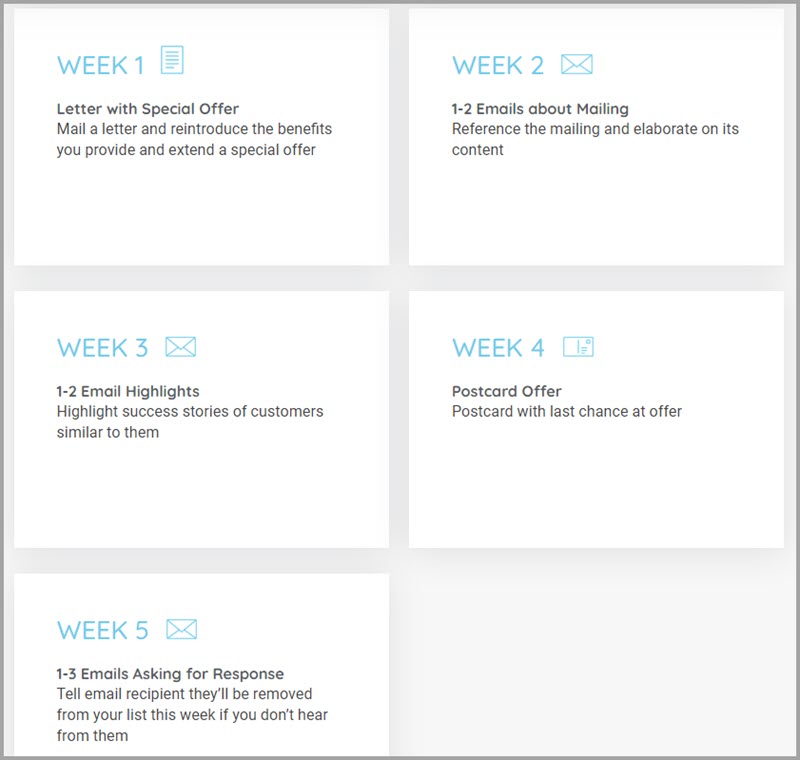


Whether you combine other channels or not, it’s important to understand that a successful multi-touch direct mail campaign requires more than simply sending out several mailings one after the other. When each is strategically timed to influence prospects along the buying journey, you can enjoy more successful results.

Attribution Makes Direct Mail Click

You see, what makes direct mail an exceptional offline media channel is that you get precise attribution you don’t get with mass media such as print ads or TV.

By using automatically generated, personalized URLs (pURLs), you can track online response (or non-response) across each “mail drop” or touch of a multi-touch direct mail campaign.. By using pURLs as the “bridge” between your mailings and the online experience, you get both the impact and high response of direct mail and the tracking and analytics you expect from digital marketing channels.

An example campaign: How multi-touch mailings multiply results

Here’s an example that shows how multiple mailings might work. Let’s assume that you sell an e-learning solution offering home-based tutoring in a wide variety of skills for students in grades K-12.

You might start a campaign with an initial sequence of three different direct mail packages (which could be sent along with email) each focusing on a different benefit — perhaps based on skills taught, age range, ease of use, etc.



A response to any of the three mailings would trigger another sequence of the multi-touch direct mail based on that specific benefit.

If there’s no response to the first mailing, you send another, and then another. If there’s no response after three mailings, you might give up on that prospect (for now, anyway).

If you do get a response, another sequence designed around the benefit that drove that response begins. These mailings might include a higher commitment offer — for example, a sales call. If there’s no response, that specific sequence might continue for another two or three mailings.

Here’s how these multi-touch marketing sequences look. First, you’d have three initial emails designed to segment prospects into specific follow-up mailing sequences:

Initial flow

No response Response

Offer A1 Offer A2 Responder Flow X

Offer A2 Offer A3 Responder Flow Y

Offer A3 Stop mailing for now Responder Flow Z

Then, each follow-up sequence can be structured in a similar way – but customized to the first offer the prospect found relevant:

Responder Flow X No response Response

Offer X1 Offer X2 Sales call

Offer X2 Offer X3 Sales call

Offer X3 Stop mailing for now Sales call

Responder Flow Y No response Response

Offer Y1 Offer Y2 Sales call

Offer Y2 Offer Y3 Sales call

Offer Y3 Stop mailing for now Sales call

Responder Flow Z No response Response

Offer Z1 Offer Z2 Sales call

Offer Z2 Offer Z3 Sales call

Offer Z3 Stop mailing for now Sales call

You can intersperse email into this flow, allow for special mailings to be sent if a prospect visits your website, a specific web page, or downloads a specific resource. Yes, this seems as if this flow would be complex to set up, but today’s automated direct mail platforms integrate with marketing automation tools to make this exceedingly easy and affordable.

Even just a few years ago, a multi-touch campaign like this would be far too complex and costly to execute. For example, sending a direct mail piece within a few hours of a visit to your website might mean sending only a few mailings per day. The fixed costs of setting up printing and mailing — which are the same whether sending 10 or 10,000 pieces — would have been prohibitive.

So don’t give up – at least not too soon. Because if at first you don’t succeed, that next mailing could be the one that triggers a profitable sale.

Automated segmentation for multi-touch marketing


Better yet, today’s direct mail tools are automated to segment your audience based on their response (or non-response) and send subsequent direct mail pieces with specific creative customized for each segment.


Each part of a multi-touch direct mail campaign can be scheduled to target these precise segments through simple campaign wizards — without the need to manually tabulate responses and build lists for each mailing.

For example, if you send a direct mail postcard and get a response to a specific offer, you may send another direct mail piece, perhaps a thank you letter, a week later with another offer.

If you don’t receive a response, you might send another postcard, perhaps highlighting a different benefit of the same offer.

You can even test various approaches as your campaign continues – so you can gain even more insights into what works and what doesn’t. For more information on best practices for testing, review my latest post here

DentalLabSupport.com


Sponsored By:
 Pm Tech


Tuesday, January 8, 2019

How advanced features like call recording prove ROI

Related image

In our quest for bigger and better sources of marketing data, it’s all too easy to get stuck on the analytics treadmill and ignore the information that’s you’ve already collected. Fortunately, when you use advanced call tracking software to analyze your campaigns, the information you need to achieve superior ROI is often right at your fingertips.

And one of the DentalLabSupport's features that best demonstrates how marketing tech can empower you to work smarter, not harder, is Call Recording. With our call recording features activated for your account, you’ll be able to play back recordings of every single call that comes in to your tracking numbers.
This is a great way to get an at-a-glance view of how your phone team is performing, but the usefulness of this feature far exceeds surface-level analytics.

Don’t let a single call slip through the cracks

During our many case studies, we heard a lot about how powerful call recording can be when used in conjunction with our DLS call tagging system.
With our comprehensive tagging system, you can quickly and easily categorize calls — like new leads, repeat callers, and missed calls —  and then identify those that should be reviewed for deeper analysis.

Proper categorization of inbound calls is a powerful way to prove the value of the work your agency does for clients. For example, with a thoughtful tagging and analysis scheme for your data, combined with a careful review of the corresponding call recordings, you can demonstrate how your campaigns have resulted in a steady increase in calls that deliver qualified leads for your client. Or, perhaps your advice on efficiency has helped a client pare down the number of missed calls per month, resulting in fewer frustrated voicemails from prospects.
In both cases, this can be a powerful demonstration of the value — and the ROI boost — your work is delivering for your client. And even better, much of this tagging work can be automated when used in concert with our suite of Conversation Intelligence automation tools.

Identifying and filling skill gaps

Beyond tagging, call recordings are also a supremely useful resource by themselves. Your agency might not have considered that call coaching could be a selling point for clients, but we’ve seen plenty of testimony from DentalLabSupport users that suggests otherwise.

With call recording enabled for the client’s account, you can instantly achieve a frontline view of how your dental lab's phone team is performing. By reviewing recordings of inbound & outbound calls, you’ll be the first to know whether the client’s team is sticking to the script and performing well, or whether there are skill gaps that are causing prospects to drop out of the sales funnel.

Let’s say that your dental laboratory is getting a healthy number of inbound calls, but you’ve crunched the numbers and it seems like prospects just aren’t converting at the rate they should. This is a perfect time to dive into the call recordings and see whether your phone team is having trouble sticking to the script, or effectively conveying their product’s value to callers.

By listening to call recordings, your dental laboratory can then take a direct hand in shaping how the call team is performing. Perhaps the sales script needs some tweaking, in order to better reflect the search keywords that are driving the most calls. If many callers are searching for a specific feature before calling, but the call recording then reveals that the feature isn’t part of the sales team’s usual script, you’ve just identified a key gap that needs to be filled.

Taking a comprehensive, hands-on approach when it comes to call recording will do more than just help your dental labs's bottom line — it provides real proof that your dental lab is driving results.

Here at DentalLabSupport.com we’re constantly developing innovative new tools like Account Center, which helps your dental labs marketing team manage multiple clients with simplicity and ease.


Building client partnerships that last

A careful and considered use of marketing technology can give you a real competitive edge and set you apart from other dental laboratories, who are always looking to entice clients away from you (IE, the competition). With advanced call tracking and analytics in your arsenal, you’ll be well-equipped not just to deliver real value, but also to prove the value of your marketing efforts in a way that establishes trust, and builds relationships that last.

Interested in seeing the benefits call tracking can bring to your dental lab? request a personalized demo of DentalLabSupport.com Sales & Marketing Platform. Call 888-715-9099 or info@dentallabsupport.com


Tuesday, June 19, 2018

Dental Lab Marketing Software


Image result for marketing software
Dental Lab Marketing Software is a collection of web systems and applications that help dental labs expand their outreach with profitable and engaging campaigns. There are many types of marketing programs, but most of them are not designed for dental laboratories. LabCell Dental lAb Marketing Software offers campaign management, resource optimization, and offer features such as data collection, branding, event scheduling, content distribution,lead nurturing and converting. The most advanced dental lab marketing software also comes with a handy analytical suite for you to generate accurate reports. 

Key Features of a Dental Lab Marketing Software

A top quality marketing software app can help you make the most of your leads and maximize sales. Look out for the following essential components while selecting a suitable system:
  • Lead Management – The software should enable you to attract buyers and nurture them with personalized campaigns. You can then pass them on to sales to close deals. You should be able to identify promising leads to be able to close faster. Improve your marketing efforts by tracking effective campaigns. Use automated, personalized campaigns to engage potential buyers at all stages of their lifecycle.

  • Sales Insight – The marketing software should help your sales team to prioritize and interact with promising leads to close deals faster. You should be able to identify hot leads and engage them with smart campaigns. Understand the moments when a lead shows interest in buying your product. This can help your reps be prepared at all stages of the sales cycle to engage promising leads at the right time for effective results, as well as to maximize conversion ratios and boost profitability and customer satisfaction.

  • Email Marketing – The marketing software should have a useful email marketing component. You should be able to prepare a detailed profile of your target customers and engage them with relevant email marketing messages based on their demographics, preferences, and individual behaviors. The app should offer smart automated A/B testing to help your improve the outcomes of your campaigns. It should provide in-depth reporting and analytics features that help you get a clear idea of the impact and ROI of the emails you send to prospective customers.

  • Social Marketing – The software should help you use social media websites effectively to learn about your customers. You can use these networks to get new customers, engage existing customers and create brand advocates by engaging them using referrals programs, sweepstakes, polls etc. You should be able to offer shareable videos and social media sharing buttons to enable your customers to share your content with their social contacts. Plus, the software should offer social metrics to see which social marketing activities drive conversions and sales, and should cover traditional media in an equally good and personalized way.

Benefits of Dental Lab Marketing Software

Our in-depth comparisons indicate that these are the main benefits companies experience when using a solid online marketing system:
  • Focusing on the final business mission. The first effect of optimizing and automating marketing is free time to focus on more important aspects of the business flow. Without such system, poring proper analytics and researching marketing opportunities would take significantly more time and money.

  • Marketing consistency. Automated marketing eliminates the risk of human error, as there is only software to control the wheel, and such cannot be influenced by opinions and feelings, or interrupted as an employee could. Therefore, the entire marketing strategy is smoother and more consistent, and you have a variety of tools to promote your business even when you’re not directing it.

  • Quality reporting. Quick and efficient reports are the dream of every busy company struggling to outreach and identify changes and optimal decisions. Marketing software is tailored for the purpose, as it usually comes with a set of advanced reporting tools, which are as well customizable and easy to personalize.

  • Lead nurturing. This is a benefit many companies don’t expect, but marketing software is indeed empowered for lead generation and nurturing. Assuming that your business relies on leads too, you can use these systems to reach as many people in the cyberspace as your business needs.

  • Multi-channel efficiency. The internet is good because it allows us to connect with people in many different ways, which can be even more valuable in the business sense of the word. You can use your marketing automation system to reach people through emails, social media, remarketing, ads, and so on.

  • Eliminating practices that don’t work. Obtaining a perfect batting average is the blessing of few, and that’s not because most marketers don’t work, but rather because they don;t have a clean insight on what they’re doing. Soon after implementing a marketing automation software you will see the difference in the performance of your campaigns, and you can use its valuable analytics to improve the least efficient ones.

Latest Trends

Good quality marketing software systems are evolving and reinventing themselves to keep up with the changing times. Here are four important trends in the continuing development of marketing software:
  • Systems are Becoming Easier to Use – Many users are put off by marketing software systems with complicated interfaces. As more and more businesses are opting to use marketing automation over standard email marketing, vendors are making it simpler for these companies to adapt by making sure their systems are easy to learn and use.

  • Computing Everywhere – Mobile devices are becoming more popular and this trend is creating major challenges for businesses. Good quality marketing software apps are catering to this trend by ensuring their systems are accessible on popular mobile platforms to enable users to be productive even in the field.

  • Social Intelligence – Canny marketers are making use of social intelligence to stay ahead of the pack. They are using social media channels to listen to their customers and become more responsive to their needs and feedback. Social intelligence is helping marketers to look into the future and optimize their products effectively to cater to changing customer requirements.


For more information about Dental Lab Marketing Software, visit DentalLabSupport.com or call 888.715.9099 

Tuesday, December 20, 2016

Email Headlines targeted to Dentists

Image result for email headline

How to Make the Most of your headlines to Optimize Your Email Marketing


For many dental laboratories, picking the most relevant and successful digital marketing channel is a crucial step to achieving sustainable success. Limited budgets and time means not being able to accomplish a 'blanket approach'; instead, you have to find the channels that work best for your needs.
But in most cases, growing your dental lab is still most effective through email marketing. That is only true, of course, if you get the subject line right.

Maximizing Your Open Rates

What makes your audience decide to actually open your email? Given that the average Dentist now receives more than 30-45 emails every single day, that question is central to determine your email marketing success. 
The answer is obvious: your subject line. While other factors, such as the 'From' name and email, also play into the equation, the subject gives your recipients a distinct idea of what the email is about, and whether they will derive any value from reading it. If the answer is no, your message never even stands a chance.

Conveying Value

Given the importance of your subject line on audience attention and open rates, your subject line has to convey the tangible value that your recipients get from actually opening it. In other words, you need to explain exactly what the email is about, and why your audience will not regret the read.
One way to convey value without getting into too many specifics is to personalize your email. If you can give your audience the idea that they're being spoken with rather than marketed to, your open rates will increase drastically. In fact, personalized subject lines provide a significant lift in open rates regardless of industry.

Technical Best Practices

The above tip sounds obvious - until you realize your restrictions. Especially as more of your readers will view your emails on mobile devices, you absolutely need to keep your subject lines short. Research shows that on average, subject lines between 61 and 70 characters in length receive the highest open rates.

Avoiding Spam Filters

Your subject line can also make a crucial difference in whether or not your email message lands in your recipients' spam folders. Email clients keep a list of so-called trigger words, which tell them that a message is too promotional and probably not relevant or honest. Avoid these trigger words at all costs.
But don't forget about manual spam filters, either. if your subject line seems overly promotional, or the body of your email does not follow up on the promise your subject makes, your audience could report the message as spam. Make sure that both your subjects and the actual messages are consistent and relevant to your audience.

Testing to Achieve Success

Finally, email subject lines offer a perfect opportunity for A/B testing. All of the above best practices apply to most industries - but who's to say that your audience behaves exactly the same way? The only way to find out is to try two variations, and send them to two random segments of your intended audience. Depending on which of these audiences opens more emails, you know which subject line worked, and can use it (or learn from it) in future messages.
For more info visit DentalLabSupport.com or call 1.888.715.9099

Wednesday, October 5, 2016

Email Marketing: Key Performance Indicators to Watch


Email Marketing: Key Performance Indicators to Watch

Email offers a cost-effective marketing solution for dental laboratories. Some dental labs even claim that it's 20x more cost effective than traditional advertising. But if you're looking to capitalize on this promotional method, you'll need to watch the following email marketing key performance indicators (KPIs).

Bounce Rate

Wouldn't it be great if every email you sent ended up in the recipient's inbox box? Assuming you have a decent number of subscribers, this typically won't happen. Some of your emails will reach the recipient, while others "bounce." The recipient's email server rejects these bounced emails, returning them to the sender. Conventional wisdom should tell you that a high bounce rate indicates a more serious underlying problem, such as poor delivery practices, irrelevant content, technical errors, etc.
There are two primary types of email bounces:
  1. Hard bounce -- occurs when the email address is either invalid or doesn't exist.
  2. Soft bounce -- occurs when the recipient's inbox was full, email server was down, or the message file size was too large.

Open Rate

Arguably, one of the most important email marketing KPIs to watch is open rate. Just because your email reaches the intended recipient doesn't necessarily mean that he or she will open it. If the recipient doesn't recognize your email, or if he or she isn't interested in your message, it can count against your campaign's open rate. For instance, if you send an email to 1,000 recipients, 75 of whom open it, your campaign's open rate is 75%.

Subscriber Growth Rate

Are you gaining or losing subscribers to your email newsletter? Monitoring your campaign's subscriber growth rate answers this question, allowing you to further optimize your emails and attract more subscribers.
To calculate your subscriber growth rate, take your total number of news subscribers, subtract it by your number of unsubscribes, and divide this number by the total number of email address in your list.
For instance, if you have 100 new subscribers, with 10 unsubscribes and 1,000 total email addresses in your list, your growth rate would be 9% (note: the actual total for the equation is 0.09; you need to multiply this number by 10).

Click-Through Rate

Click-through rate (CTR) is another email marketing KPI to watch. This is the percentage of recipients who click on the promotional link in your email.
CTR is calculated by taking the total number of recipients and diving by your unique clicks originating from the email campaign. If 800 prospects received your email and 160 clicked the link, your CTR is 20%. Maintaining a high CTR is essential for a successful email marketing campaign.

Here are some tips to improve your email CTRs:

  • Split test different call-to-action (CTA) placements in your emails to see what works and what doesn't.
  • Use a responsive design, ensuring your emails load on both desktop and mobile devices.
  • Segment your email list based on user demographic. Doing so allows you to personalize your messages for a higher CTRs.
  • Keep it short. Long emails tend to suffer from low CTRs.
  • Include social media sharing buttons. According to a study conducted by eConsultancy, this alone can increase email CTRs by as much as 30%.

Conversion Rate

Of course, you should also monitor your emails' conversion rate. Conversion rate, as you already know, the percentage of recipients who not only click your promotional link but also follow through by taking direct action. For some marketers, a conversion occurs when the recipient buys a product or service. For others, a conversion occurs when the recipient inputs his or her personal information.
These are just a few of the most important metrics to watch with your email marketing campaigns.
To learn more about email and other digital marketing strategies for small businesses, contact us today 1-888-715-9099 or info@dentallabsupport.com. DentalLabSupport.com offers Email Marketing Management solutions for Dental Labs of all shapes and sizes.